
Newsletter No 5/14 February 2025

To agents, manufacturers, distributors & wholesalers. Please upgrade your 1 line listing to a business listing at least. The Sourcing Directory and Newsletter is dependent on industry support and your business listing offers potential clients more information about your company, products, branches, agents etc.
The cost of a business listing for the entire year is only R1400.
To add a logo is an additional R440. carla@newsbriefs.co.za


Click on any ad to go to the advertisers website

Optimize climate change management and corporate responsibility in fashion supply chains

‘Integrating Climate Change Management and Corporate Sustainability in Fashion Supply Chains’ takes place on February 26, 2025.
Geneva (February 10, 2025) – SGS, the world’s leading testing, inspection and certification company, is hosting an exclusive expert-led webinar on February 26, 2025, to provide key insights into climate change management, corporate sustainability and environmental, social and governance (ESG) frameworks tailored for the fashion industry.
As the 2030 review of the Paris Agreement approaches, forward-thinking businesses are accelerating efforts to reduce greenhouse gas (GHG) emissions, integrate circular economy principles and adopt sustainable strategies.
This one-hour webinar, available in two sessions, will equip attendees with the latest carbon reduction strategies, regulatory updates and practical guidance on developing a robust ESG framework. It will also cover life cycle assessment (LCA) and product environmental footprint (PEF) – essential methodologies for assessing and minimizing environmental impact.
SGS experts hosting the webinar are Jialun Zhang, Global Technical Support Section Head, Softline, and Dr Min Zhu, Senior Director, Technical Services and Operations, Softlines. Both have extensive experience in sustainability, chemical management, global compliance and corporate decarbonization strategies.
The webinar is designed for fashion industry professionals, including sustainability managers, buyers and business owners. Attendees will gain practical strategies to reduce environmental impact, supporting international market expansions and strengthening corporate brand reputation.
For more information and to register visit::
Session 1 – February 26, 10:00 AM CET
Session 2 – February 26, 4.00 PM CET

Nairobi Fashion Week 2025 puts regenerative fashion in the spotlight

Image by Daniel Kempf-SeifriedImage by Daniel Kempf-Seifried
The Nairobi Fashion Week 2025, one of East Africa’s most influential fashion events, has put an emphasis on regenerative fashion, highlighting the urgent need for sustainability and ecological responsibility in the industry
The theme for this year’s event, “Regenerating Fashion: A New Era of Responsibility,” captivated both local and international audiences, offering a glimpse into the future of fashion through the lens of environmental consciousness and sustainable innovation.
This year’s show was a reflection of the global conversation on the importance of shifting from a traditional “take-make-dispose” fashion model to one that actively contributes to the environment.
Designers, brands, and thought leaders from across the continent gathered to explore and celebrate the concept of regenerative fashion — an approach that focuses not only on minimising harm but also on healing and replenishing the planet.
The Textile and Apparel industry (T&A) is reportedly the third-largest manufacturing sector globally, generating $2.4tn of revenue in 2019.
Sadly, even with these statistics that depict the relevance of the sector, the fashion industry is a major contributor to textile waste and carbon emissions, with billions lost each year due to the underutilisation of clothes and lack of recycling.
It is estimated that the sector produces around 92 million tonnes of textile waste each year, which is equivalent to a rubbish truck full of clothes being dumped every second. When it comes to the impact of second-hand clothes or mitumbas, it is estimated that in recent years over 300 million items of damaged or unsellable clothing made of synthetic – or plastic – fibers are exported to Kenya annually, where they end up dumped, landfilled, or burned, exacerbating the plastic pollution crisis.
Pushing boundaries
With the global fashion industry accounting for significant environmental challenges, the Nairobi Fashion Week 2025 featured designers who are leading this change, pushing boundaries to make recycling and upcycling integral parts of fashion production and consumption.

Image by Daniel Kempf-Seifried
The event also provided a platform for industry leaders, environmental activists, and sustainability experts to discuss the future of recycling in fashion and the broader potential for a circular economy in the industry.
Additionally, it served as a platform to discuss the rising importance of circularity and regenerative practices in the fashion industry. Designers showcased collections that were carefully crafted from upcycled materials, and zero-waste production methods, demonstrating that fashion can be both beautiful and responsible.
Many designers also incorporated locally sourced materials, supporting Kenyan craftsmanship and the growing demand for ethical fashion.
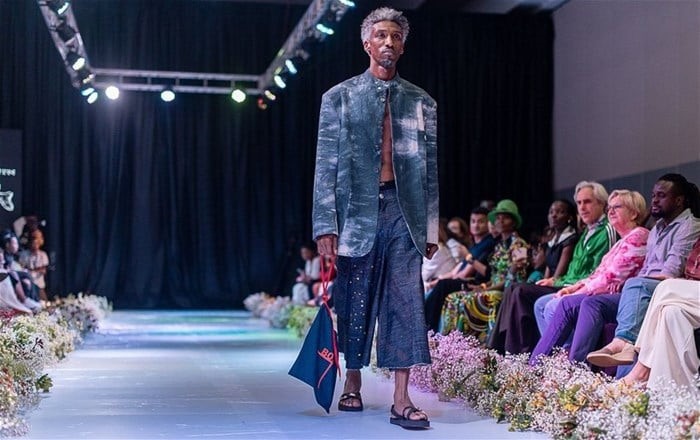
Image by Daniel Kempf-Seifried
“We believe in the power of fashion to lead positive change, and this year’s showcase was a bold step toward creating a regenerative fashion ecosystem,” said Brian Kihindas, the creative director of Nairobi Fashion Week.
“It is time for fashion to evolve, and as an industry, we must move from sustainability to regeneration. Nairobi Fashion Week has become a catalyst for this transformation, showing the world that Kenya can lead the charge in global fashion innovation.”

The Foschini Group Limited
Notification of change in the composition of TFG’s Social and Ethics Committee
In accordance with paragraph 3.59 of the JSE Limited Listings Requirements, the Board of Directors of the Company wishes
to advise shareholders that Ms Boitumelo Makgabo-Fiskerstrand has been appointed as the Chairperson of its Social and
Ethics Committee. Shareholders are further advised that Mr Michael Lewis has been appointed as a Member of the Social
and Ethics Committee. Both appointments will take effect from 12 February 2025.
Accordingly, the Social and Ethics Committee will be comprised as follows:
– Ms Boitumelo Makgabo-Fiskerstrand (Chairperson of the Committee, Independent Non-Executive Director)
– Mr Michael Lewis (Independent Non-Executive Director)
– Mr Anthony Thunstrom (Chief Executive Officer, Executive Director).
All other Board Committees remain unchanged.

Company Profile:-
The Industrial Clothing Company: 30 Years of Excellence in Workwear & Bushwear
As The Industrial Clothing Company (PTY) Ltd celebrates its 30th anniversary in November 2024, it stands as a testament to quality, resilience, and industry leadership. Since its establishment in 1994, the company has grown to become the sole distributor of Javlin Workwear, Paramount Workwear, and Salty Bushwear in South Africa, catering to the demanding needs of professionals in industrial, agricultural, and outdoor environments.
At the heart of The Industrial Clothing Company’s success is a commitment to providing durable, functional, and stylish workwear. Javlin Workwear is renowned for its rugged durability and performance-driven designs, ensuring tradesmen and industrial workers stay protected on the job. Paramount Workwear continues to set the standard for reliability and comfort, while Salty Bushwear, with its roots dating back to 1957, captures the essence of African adventure and outdoor exploration.
Beyond its impressive portfolio of brands, The Industrial Clothing Company has earned a reputation for exceptional customer service and industry expertise. By forging strong relationships with businesses, workshops, and professionals across the country, the company ensures that quality workwear is accessible where it’s needed most.
As it steps into its fourth decade, The Industrial Clothing Company remains dedicated to innovation and excellence. With a deep understanding of the South African workwear and bushwear landscape, the company is well-positioned to continue its legacy of supplying premium apparel that meets the evolving needs of industry professionals and outdoor enthusiasts alike.
Here’s to 30 years of quality, service, and strength— and many more to come!
http://www.industrialclothing.co.za/

The Ancient Egyptians used perfume in religious rituals to make them smell nice.
Before 1850, people used to hand-stitch their own clothes. Clothing was seen as essential rather than fashionable among the poor.
Pregnancy was considered fashionable in the 1600s. Women would often put cushions underneath their clothes to try to create a realistic bump

Editorial Submission:
Please remember to send me your news so that we can share it with all our readers in the weekly newsletter. Although editorial is neither guaranteed nor implied, suitable editorial for consideration may be submitted to:-
