
Newsletter No 40/18 October 2024


NewsBriefs wants to share your company profile.
If you are a manufacturer or supplier to the Clothing & Textile trade please send us your company profile on a word document up to 500 words explaining what your participation is to the industry.
You can also supply one visual in jpeg or png format.
Our aim is to share one newsworthy submission per week with our readers.
Although editorial is neither guaranteed nor implied, suitable editorial for consideration may be submitted to:- carla@newsbriefs.co.za
Click on any ad to go to the advertisers website

Sneaker Factory launches new urban clothing label, APX

Image supplied
APX, a local clothing brand under The Foschini Group, officially launches into the market this month.
Straight off the production line and into the top favourites in your closet, comes a label that is not cool, clean and creative, but comfortable and most importantly value for your pocket and for your style.
And in an era where value and sustainability matter more than ever, APX aims to redefine the clothing experience for South African shoppers.
As part of TFG’s Sports division at Sneaker Factory, APX was born out of the desire to provide high-quality, value-driven products that complement the footwear brands already available in their stores.
With a mission is to create versatile and effortless clothing staples that seamlessly integrate into customers’ lives, making them perfect for any occasion.
APX’s initial launch features a collection of hoodies, t-shirts and accessories designed with the modern trendsetting consumer in mind. Each piece embodies the principles of great value and comfort, making them ideal for casual outings, workouts, or simply lounging at home. The range is versatile and focuses on everyday essentials that every wardrobe needs.
APX is proud to contribute to the local industry by ensuring that 100% of its clothing is produced locally, with a significant portion of accessories like socks also made in South Africa.
In line with TFG’s broader sustainability initiatives, APX is part of The Better Cotton Initiative, focusing on ethical sourcing and production practices.
While the initial offering consists of essential clothing items, APX plans to expand its range to include headwear, flip-flops, pool slides, bags, and women’s wear. The brand is eager to evolve and adapt, exploring new opportunities such as seasonal jackets and other fashionable staples.
“We recognised an opportunity for a value-focused offering that could stand proudly alongside our existing branded merchandise. APX is not just about competition; its about enhancing the customer experience by providing quality products at accessible prices,” affirmed Sneaker Factory marketing manager, Lulama Mnisi, and added “We believe in making a positive impact not only through our products but also in the way we source materials and manufacture our clothing. Sustainability is a core value of our brand, and we are committed to continuing to grow these initiatives.
APX’s new collection will be available online as well as in selected Sneakers Factory stores across South Africa starting this month.

Master plan supporting clothing, textile businesses
By: Tasneem Bulbulia
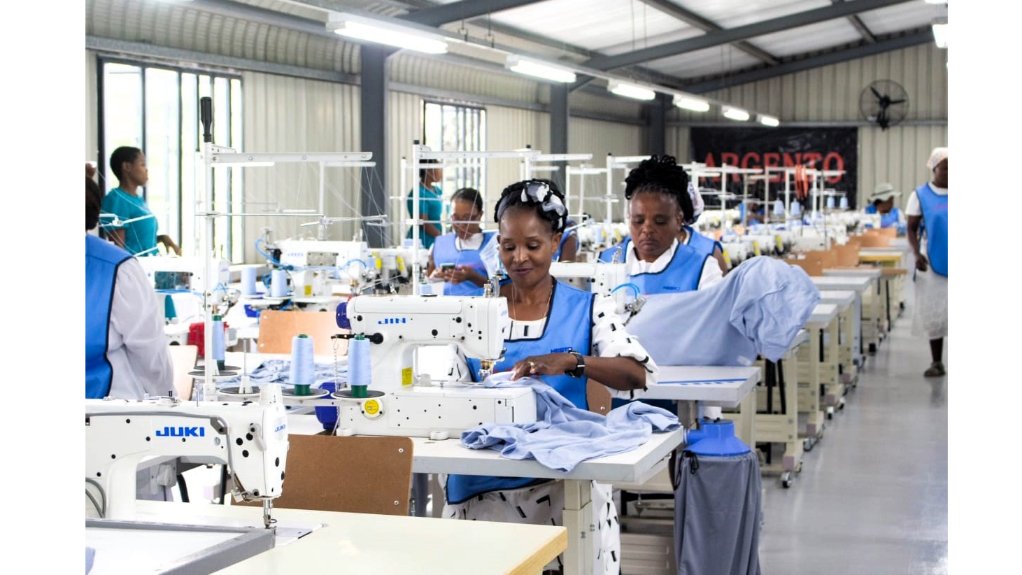
Argento Clothing machinists Senzeni Maphumulo and Nokukhanya Ntuli
The Department of Trade, Industry and Competition (dtic) has highlighted the stories of two companies that operate in the clothing and textile sector to underline the importance of sector master plans and the positive impact of the collaboration between government, business and labour on the South African economy.
One of the interventions initiated under the Retail–Clothing Textile Footwear Leather (R-CTFL) Master Plan, is the redesigned Clothing Textile Footwear Leather Growth Programme (CTFLGP), which was launched in 2022 and has contributed to the creation of more than 20 000 jobs.
Import substitution, the creation of new jobs, transformation and competitiveness improvements are the main objectives of the programme.
dtic clothing and leather director Dr Jaywant Irkhede says more than R1.87-billion had been approved for 154 businesses employing almost 24 000 people and that R1.41-billion had been disbursed by July.
One of the beneficiaries of the programme is R and L Apparel, a woman-owned company based in Newcastle, KwaZulu-Natal.
The company received financial support for the purchase of equipment and machinery, as well as for initial working capital, in order to grow its cut, make and trim (CMT) manufacturing capacity.
R and L Apparel MD Solis Benjie Dolores says the support enabled the company to increase its production, improve product quality, create jobs and grow its customer base, which now includes national retailer The Foschini Group (TFG).
The business supplies its goods to TFG through Celtico, one of the CMT suppliers in the Newcastle clothing industry.
“The funding assisted us greatly in creating additional jobs. We had only 17 workers when we applied for the programme. As of August, we were able to reach a staff complement of 103 employees, 98 of whom are women.
“We are looking forward to achieving the additional 150 jobs that we have committed to,” Dolores highlights.
“The CTFLGP is a great initiative. The programme opened new doors for our company’s growth. Without the funding, we might have just stayed on 17 workers, because our machinery and working capital were very limited.
“Before we received the funding, we were running a hand-to-mouth operation that was kept going only by the dedication and endeavours of our team. Now the company is on a positive growth trajectory,” she adds.
Dolores says the company is planning to acquire automated machinery to expand its production capacity based on market demand, as local retailers are increasingly embracing Proudly South African products.
“We are happy to contribute to import substitution, growing the economy and, more importantly, creating jobs for the local people, both skilled and unskilled, assisting them to earn a decent living,” she asserts.
Argento MD Joudalle Govender also attests to the positive impact of the CTFLGP on her company, which is based in Mandeni, KwaZulu-Natal.
The company manufactures apparel and corporate clothing for a major retailer and several corporate clients.
“We used the funding for operational expenses and to re-tool the factory with new machinery. The funding allowed us to create 45 new jobs. One hundred people are currently employed in our company, 80 of whom are women. Our profit margins increased, and we had a rapid growth in production due to the extra capacity,” says Govender.
She adds that the company is planning to expand its product lines, adopt sustainable practices, improve its manufacturing efficiency and explore new markets.
“Our future plans include expanding our current building and creating 100 more jobs. We are also looking into exporting our local garments and creating more awareness on local manufacturing in South Africa,” adds Govender.
She emphasises the importance of the R-CTFL Master Plan in promoting sustainability and innovation within the industry, which she says is crucial in adapting to changing market demands and consumer preferences.
“I love the fact that the plan focuses on several key objectives, such as job creation and increasing local production. Argento is a local champion because we produce our own local fabric in the rural area of Isithebe.
“My favourite part is that the plan enhances competitiveness in the global market, by fostering collaboration between government, labour and industry stakeholders. That is important for our economy,” stresses Govender. 

Report reveals slight increase in consumer spending in August

Picture: Steve Buissinne/Pixabay
Under-pressure South Africans are turning to their credit cards, with usage increasing by 10% year to date
Absa’s latest Merchant Spend Analytics Report for August 2024 reveals a small increase in consumer spending compared with the previous month. Despite the slight uptick, the overall trend remains cautious.
Total consumer spending increased by a modest 1% in August, accompanied by a 3% rise in transaction volumes. However, this represents a slowdown from the stronger growth seen in July. Though this marks two consecutive months of spending growth, it’s not enough to signal a significant economic recovery.
While consumer spending growth of 6% year to date outpaced inflation, it was tempered by sluggish performance in key categories such as food and clothing. These two categories, which once accounted for 69% of the market share, have seen their combined share drop to 59% as of August 2024.
In contrast, categories such as home and garden, and business and professional services — the latter includes fintech solutions — have shown robust growth, driven by factors like increasing adoption of merchant machines by small businesses.
Isana Cordier, head of consumer goods and services sector coverage at Absa CIB, attributes the slower growth in food and clothing to a shift in spending patterns. Consumers are increasingly turning to more affordable options, such as township retail, which are drawing consumers away from traditional channels. Traditional clothing retailers are also increasingly being affected by the rise of fast fashion and international online retailers at the expense of bricks-and-mortar stores.
As online shopping grows, Cordier says the bank is seeing a clear shift in consumer behaviour. However, consumers still value physical shopping experiences.
The report highlights a growing preference for credit cards among consumers, with usage increasing by 10% year to date. Debit card growth, however, has slowed to 4%. There was a modest increase in online spending of 19%, driven primarily by categories such as home and garden, business and professional services, food and clothing.
Looking ahead, the recent introduction of the two-pot retirement system is expected to stimulate household consumption. However, early data suggests a muted impact on consumer spending in September, possibly due to factors such as delayed payouts, tax directives and consumer uncertainty.
While the current situation may seem bleak, Cordier noted that the financial health of consumers has been under strain for a prolonged period. A rebound in consumer spending will likely depend on improvements in economic conditions, including further interest rate cuts, lower inflation and higher employment levels.
The Absa Merchant Spend Analytics Report, issued monthly, leverages Absa’s merchant data, a unique advantage stemming from the bank’s position as Africa’s largest merchant acquirer. Using internal data, it examines patterns and trends, providing a deeper understanding of consumer preferences, behaviours and spending power across various categories, while offering valuable perspectives on broader economic conditions.
The big take-out: A recovery in consumer spending will likely depend on improvements in broader economic conditions. 


No wonder those at the top of the fashion world are so wealthy – the industry has an annual revenue of more than $20 billion.
Technically, items are only “vintage” if they were made more than sixty but less than a hundred years ago.
“Retro,” on the other hand, doesn’t refer to old items but rather to styles that copy vintage items.

Editorial Submission:
Please remember to send me your news so that we can share it with all our readers in the weekly newsletter. Although editorial is neither guaranteed nor implied, suitable editorial for consideration may be submitted to:-
