
Newsletter No 37/27 September 2024


NewsBriefs wants to share your company profile.
If you are a manufacturer or supplier to the Clothing & Textile trade please send us your company profile on a word document up to 500 words explaining what your participation is to the industry.
You can also supply one visual in jpeg or png format.
Our aim is to share one newsworthy submission per week with our readers.
Although editorial is neither guaranteed nor implied, suitable editorial for consideration may be submitted to:- carla@newsbriefs.co.za
Click on any ad to go to the advertisers website

Sactwu fashions a way forward
By Crystal Orderson
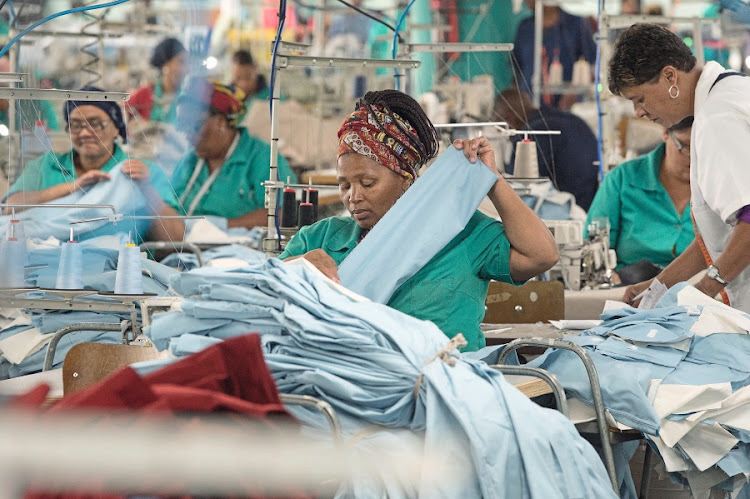
Navigating the challenges: Workers at Kinross Clothing manufacturers in Maitland, Cape Town, in 2017. The sector lost thousands of jobs in the 1990s, but there are plans to revive the local industry. Picture: Gallo Images/AFP/Rodger Bosch
With its rich investments, the clothing union this month celebrates 35 years of survival in a brutal sector
At a time of high unemployment and diminishing trade union influence, the Southern African Clothing & Textile Workers Union (Sactwu) this month celebrates 35 years of growth and wealth — but not without a little despair.
Sactwu was founded in 1989, when the Amalgamated Clothing & Textile Workers’ Union of South Africa merged with the Garment & Allied Workers’ Union of South Africa. Its membership has fluctuated from 100,000 during the jobs bloodbath of the 1990s to 186,000 in 2019, to 126,000 today.
Sactwu general secretary Bonita Loubser says unions have a role to play and a duty to respond to the country’s challenges. She says the unemployment crisis gives her union sleepless nights. “How can we sleep peacefully when we know unemployment is as high as it is?” she asks. The latest unemployment figure of 33.5% means 8.3-million people have no work.
“We can’t rely on the state only to deal with the issues, and this is where trade unions come in to help our members and their families,” says Loubser.
When she was a teenage activist in Mitchells Plain on the Cape Flats in the 1980s, choices for a young unemployed woman were limited. One was to join thousands of other women in a clothing factory. Loubser got a job, was appointed a shop steward and in 2023 became the first woman to head the union as general secretary.

Bonita Loubser. Picture: Supplied
“As a young mother who was active in the anti-apartheid movement. I became interested in workplace challenges and became a shop steward,” Loubser tells the FM from her office at the Sactwu building in Salt River, the heart of Cape Town’s clothing sector.
Insiders who have worked with Loubser say she understands the realities of a machinist working in a factory because that is where she started, and her rise is due to her dedication to union members. The union remains worker-led but has managed its finances so well that it is also one of the wealthiest.
In 1997, Sactwu formed Hosken Consolidated Investments (HCI), led by its general secretary, Johnny Copelyn. He became the CEO of HCI, in which Sactwu remains the biggest shareholder with 23.3%. HCI started with R2m in union savings and today has interests in media, hotels, casinos, coal mines and the transport sector.
Loubser says the union had extensive debates on the role investments should play and wanted to ensure it helped with self-sufficiency and real transformation for workers. “We were very clear at the time that there should be a total separation in how we manage and deal with investment arms: they have to be separate entities,” she says. “We do not conflate our investment strategic decisions. We have a separate board that manages the investment.” All investment decisions are taken in consultation with the national executive committee, she adds.
Matthew Parks, the parliamentary officer of labour federation Cosatu, of which Sactwu is part, says the union has ensured its members are at the centre and has not allowed union investments to divide it. “Unions get divided on investment funds, but Sactwu has managed it tightly and there has been no misbehaviour taking place; proceeds have been ploughed back to its members.”
Former trade unionist and longtime Cosatu Western Cape provincial leader Tony Ehrenreich says: “Sactwu was careful … but it’s also had to deal with the realities of having been in power. It has had its challenges and took decisive action, and the leadership crafted a strategy to deal with investment issues.”
He says in some cases investment companies have caused problems for unions because of greed. There have been horror stories of how unions interfere in investment arms, but Sactwu has kept its hands clean.
One of the big challenges the union faces today is the rise of cheap Chinese imports, especially from Shein and Temu, that have almost killed the sector.
Loubser says the union survived tough times before, including the near destruction of the sector when South Africa joined the General Agreement on Tariffs & Trade in 1993 and became a member of the World Trade Organisation in 1995. This led to trade liberalisation and huge cuts in tariffs and subsidies. Despite this, the union continued to fight for fair wages and working conditions, says Loubser. She is optimistic about the future of the sector.
For decades, it was a major source of employment for women, especially in the Western Cape, KwaZulu-Natal, the Free State and Gauteng, and in the cities of Cape Town, Durban and Joburg.
Loubser says the union knew it would face the challenges of globalisation but the Growth, Employment & Redistribution (Gear) policy, passed in 1996, had a brutal effect on workers.
Parks adds: “We lost so many jobs — 100,000 overnight — that it crippled the industry; [it is] a sector that has now recovered and is creating jobs. It has a great future if we look at how it has expanded local procurement.”
Trade unionists the FM spoke to say Sactwu could have easily succumbed to cheap imports and the closure of factories, yet it strategised with manufacturers and retailers, fought to keep factories open and worked with the sector to save jobs.
“It took the biggest hit in 1996 with Gear,” says Ehrenreich. “Sactwu took a huge knock and we have to recognise it played an exceptional role in navigating the challenges. It has invigorated the sector and also put in place measures to deal with changes.
“It’s the only sector in the country that looked after its members. Sactwu is not overtly political, but it will tell the government and companies [to] be strategic about the positions they take to ensure members keep their jobs.”
According to a recent report by research institution Trade & Industrial Policy Strategies, employment in clothing and textiles manufacturing has fluctuated over the years, reaching its highest level in the first quarter of 2019 with about 186,000 workers — a 14% increase from 2010.
Yet the department of employment & labour says trade union membership is declining and now stands at 23%.
Sactwu has one of the biggest high school programmes for the children of factory workers, a post-matric bursary scheme and a medical scheme. It has also ensured that members are able to access education and training, and in some rural areas is involved in ensuring that people have access to drinking water.
Parks says Sactwu has adapted and listened to its members. “It has survived because the leadership is in touch with the members and are on the ground. It has learnt from its mistakes, managing internal divisions that can often destroy unions.”
Sactwu also played a pivotal role in the 2030 master plan for the industry, which includes retailers. Director of research Simon Eppel says the plan evolved over 15 years of engagement. “We went through intense periods of fighting … we were against each other but realised we needed to have a different approach and work together to solve problems,” Eppel tells the FM.
The plan was finalised in 2019 and the aim was to bring together retailers, manufacturers, the government and labour to create a value chain that provides customers with products and is invested in growing employment and advancing inclusion and transformation.
“We agreed to disagree, we don’t love each other; retailers are not trade unionists and vice versa, but there must be a minimum threshold of interests between us and that is the major part of the master plan,” Eppel says.
In accordance with the plan, several teams were also set up to look at different activities to grow the industry, including the formation of a team aimed at limiting illegal imports and collaborating with the South African Revenue Service (Sars) and other stakeholders to reassess tariff structures.
In August, Sars announced it will impose both VAT (15%) and a 20% import tax on small parcels from September as an interim measure; Shein and Temu have been using a loophole to get products into South Africa. The final “appropriate” duties on a range of goods will go into effect on November 1. Temu and Shein customers were paying a minimal price for importing clothing and other products through the online offshore retailers.
“The abuse of small parcel rules saw a united front in the industry, from manufacturers to retailers and the unions. The government was sympathetic and the question was how it would be tackled. It has come up with a suitable resolution to close the loophole technically, but it’s not about to be the end of the problem,” says Eppel.
The new measures aim to level the playing field for local retailers and encourage consumers to support domestic businesses. But the union says it is naive to think everyone will accept it, and there may still be challenges ahead in enforcing compliance.
As Loubser reflects on its 35 years of existence, she says the union will be around for decades to come. “We are a modernised and strategic union. We are going nowhere and we will still be standing for years to come.” 

Learn about effective digital chemical management for textiles with the SGS SMART Cares webinar

SGS, the world’s leading testing, inspection and certification company, is delighted to host a complimentary webinar, ‘Digital chemical management for textiles with SGS SMART Cares’, on October 16 and 23, 2024. This event will be suitable for suppliers, such as wet processing plants using chemical formulations, and brands looking to adopt sustainable chemical management.
Chemical processes in the textile industry, such as dyeing, finishing and printing, often involve chemicals that are increasingly unacceptable to consumers and stakeholders. Complying with strict regulatory requirements requires rigorous practices, and navigating complex supply chains can make it difficult for businesses to implement the necessary changes for sustainable operations.
This webinar will introduce SGS SMART Cares, a digital platform that supports businesses in adapting their production processes efficiently and innovatively. Presenters Daniel Zhao (on October 16) and Brenda Chiu (on October 23) will discuss the benefits of SGS SMART Cares, including building a comprehensive database of suppliers, inventories and usage information, as well as screening for restricted substances. The platform also enables the generation of ZDHC Performance InCheck reports, facilitating better interaction with brands.
Achieving sustainable chemical management requires collaboration between brands, manufacturers, suppliers and retailers. SGS SMART Cares makes this collaboration possible by promoting sustainable chemical management, enhancing workplace safety for employees, and simplifying regulatory compliance.

South African Retailers have arrived at an E-commerce crossroads

South Africa’s e-commerce landscape has arrived at an important juncture. The explosive growth observed during the pandemic years has slowed down somewhat and consumer spending power has faltered amid low economic growth and a global cost of living crisis. At the same time, competition is heating up.
Asian retailers such as Shein and Temu are upending segments of the e-commerce market, rapidly grabbing market share and increasing pricing pressure on traditional retailers. Amazon’s much anticipated entrance into the South African market is expected to further turn up the heat — potentially creating a new benchmark for customer experience.
Yet if we look at the experiences of other emerging markets, the disruption may only just be beginning. Barriers to entry for new players in the e-commerce channel are relatively low, creating space for more competition. It would be unsurprising, for example, for brands in segments like tech, durables and clothing to go direct to consumer with e-commerce.
This is akin to developments in the Middle East, where e-commerce strategies have introduced 55 new brands to the market. Amid all these developments, opportunities beckon. With the current economic climate and shrinking consumer wallets, the landscape is ripe for innovation and competition.
Consumers are becoming increasingly proactive and creative in their strategies to reduce costs — creating opportunities for innovative brands and retailers to expand their market share. Those that can offer convenience, competitive pricing, a wider range of products, and a personalised experience are likely to lead the charge in this rapidly evolving market.
Here are some of the key developments and trends to watch:
Omnichannel journeys on the rise
Our global research shows that 79% of consumer tech retail executives expect omnichannel strategies to continue to dominate. The same applies in South Africa, where a coherent omnichannel strategy is becoming a critical success factor for retailers.
It’s not enough to offer customers choices such as online shopping and home delivery, and buy online and pick-up in-store. Brands need to accommodate complex customer journeys where consumers may switch through different channels during discovery, research and purchase.
We find that many people do their research online and then buy in-store, or alternatively research in-store and then buy online — depending on price and value. Our research shows that 35% of South African shoppers agree that they use their phone in-store to help make purchasing decisions. Supporting customer choice can help retailers to maximise opportunities to acquire and retain customers.
Retailers with a real-world footprint can get an advantage by making it easy for customers to switch between touchpoints. It’s now key to consider how to leverage formats like pop-up stores as well as platforms like Mr D and Uber Eats, and marketplaces such as Takealot and Amazon to expand reach.
Saving strategies at the forefront
In the current economic climate, price sensitivity is one of the key factors shaping how consumers shop. Behaviours such as bulk buying when products are on sale and reducing trips to the shops to save petrol money are becoming more common. Consumers are on the lookout for promotions and discounts both online and offline.
Around 60% of South African consumers say they shop around different stores and online platforms to get the best balance of prices, deals and options, while nearly a third use digital technologies such as mobile apps to find better deals. Around 31% are shopping online to get better deals and save transport money. Cross-platform presence and thoughtful promotions are key to winning market share in this environment.
Long-term advantage with loyalty cards
With competition heating up and consumers becoming more price-conscious, retailers are looking to loyalty cards and reward programmes to improve customer retention and increase basket sizes. Some 59% of South African consumers shop with loyalty points to help manage spend.
For retailers, loyalty programme data is a goldmine of customer insight. Not only can it help them understand overall spending trends, but it can help them improve conversions and retention through personalisation. Artificial intelligence and machine learning are unlocking even more powerful insights for personalised marketing.
Personalised promotion strategies are more accessible thanks to online leaflets and digital loyalty schemes. They resonate well with households that are struggling to make ends meet or with buyers that need to support larger families. We’re also seeing many innovations in loyalty — for example, towards the end of last year, Shoprite launched a monthly subscription based loyalty programme offering unlimited Checkers Sixty60 deliveries.
Finding new revenue streams
Retailers and consumer brands know that amid tough economic conditions, innovation must also include the generation of new revenue streams. This might take the form of targeting new markets — as we see with Shoprite’s OK Urban brand, an innovative cashless concept store that includes an artisanal bakery and coffee shop, or Makro’s exclusive B2B online store for businesses of all sizes.
Globally, retailers have their eye on retail media networks (RMNs), a digital equivalent to in-store ads. These allow them to sell advertising space on their websites and apps to brands. For brands, RMNs offer a new means to reach important target groups already browsing a retailer’s website or app. We are already seeing this locally as well with r etail media platform Zitcha recently announcing that it is partnering with Leroy Merlin to launch a full digital retail media network across South Africa.
Another trend sees stores rent out physical space to brands. This space could be used for smart displays, kiosks, and enhanced retail experiences. As these examples show, retailers are thinking about innovative ways to maximise the value of their omnichannel presence at a time when competition is growing and consumer spend is under pressure.
Logistics excellence is essential
Retailers will have a strong focus on operational excellence in the coming two to three years. Innovative approaches will be critical here in meeting the high expectations of consumers, particularly amid tough economic conditions. One of the vital elements is how quickly consumers can get hold of the products they want.
Our Consumer Intelligence shows that people worldwide are now, in general, more concerned about delivery times and product availability than before the pandemic. South African consumers will increasingly expect to receive the products when they want, with same or next-day delivery, or a specified time slot.
We’re already seeing retailers like Takealot trial one-hour delivery for tech and other goods — an expectation that is already set for last-mile delivery of groceries. Maintaining a high and consistent level of service delivery is challenging in an environment of load shedding and vast distances — but it is a basic ticket to play.
Conclusion: Consumers in the driving seat
South African retailers are at an e-commerce crossroads, where the demands placed upon them are varied and significant. Their customers expect more engaging and personalised experiences, faster delivery, and lower prices in a tough and unforgiving competitive and macroeconomic landscape.
Consumers are in the driving seat, with more choice at their fingertips than ever. For retailers, establishing a competitive edge begins with a clear understanding of the changes. They can then invest confidently and correctly in data, logistics, technology and partnership strategies that help them meet their customers’ needs. African Retail


It is thought that the average woman will buy 145 bags during her lifetime.
The most common materials for manufacturing clothing are linen, cotton and polyester.
Metal needles are relatively new, but 30,000 years ago, they were being made from animal bones.

Editorial Submission:
Please remember to send me your news so that we can share it with all our readers in the weekly newsletter. Although editorial is neither guaranteed nor implied, suitable editorial for consideration may be submitted to:-
