
Newsletter No 33/30 August 2024


NewsBriefs wants to share your company profile.
If you are a manufacturer or supplier to the Clothing & Textile trade please send us your company profile on a word document up to 500 words explaining what your participation is to the industry.
You can also supply one visual in jpeg or png format.
Our aim is to share one newsworthy submission per week with our readers.
Although editorial is neither guaranteed nor implied, suitable editorial for consideration may be submitted to:- carla@newsbriefs.co.za
Click on any ad to go to the advertisers website
Is localisation the answer to keeping cut-price Chinese imports at bay?
By Georgina Crouth
Even with next month’s commencement of the South African Revenue Service’s import duties on small parcels, local clothing sellers will never be able to compete with the likes of Shein or Temu, which are able to flog dresses for as low as R32, or shoes for R100. Nevermind the fact that your cheap outfit won’t last a wash cycle, or that you’re adding to the industry’s waste problem.
Nor can local manufacturers match the billion-dollar advertising budget, to entice customers to “shop like a billionaire”, or hope to see hundreds of millions of dollars in Chinese government subsidies..
Where they might have a fighting chance is if they can optimise production lines and improve efficiency initiatives. By bolstering South African manufacturers’ competitiveness, locally manufactured goods could begin to replace imports on our shelves, export opportunities expanded and local procurement stimulated.
Back in 2021, the Localisation Support Fund (LSF) was established to help revitalise South Africa’s struggling manufacturing sector by addressing “challenges”, and promoting local manufacturing and exports. The public-private localisation partnership, funded by an initial R340-million injection from Coca-Cola South Africa and Air Liquide, is geared at reducing imports, increasing exports, and promoting industrial competitiveness in line with the 2021 localisation pact at National Economic Development and Labour Council.
Speaking of “challenges”: we know its government-speak for problems and in the LSF, the government and trade unions have been part of it from the start, as members are drawn from the funding contributors, the government, business and labour.
Former Department of Trade, Industry and Competition minister Ebrahim Patel was its first chairperson, although Harald Harvey, an investor, is now in the chair, with businessman Grant Pattison, Luisa Ortega from Coca-Cola, Martin Kingston from Rothschild & Co South Africa as non-executive directors, alongside Patel and Western Cape Cosatu leader Tony Ehrenreich.
Thami Moatshe, an entrepreneur with exposure to both the private and public sectors, is the executive head.
On Wednesday, the LSF, which has conducted reports on the furniture and renewable energy sectors, reported on work it had done on two Retail-Clothing, Textile, Footwear, and Leather (R-CTFL) sector manufacturers, which showed that by making improvements to manufacturing efficiency, they could become competitive, profitable and actually grow.
The two case studies — Green Thread Manufacturing (which manufactures clothing for Cape Union Mart’s Old Khaki and Poetry ranges) and KARMA Clothing (a corporate wear maker) — show LSF interventions, aimed at driving efficiency and production line optimisation, can make them profitable, and competitive.
Moatshe says that one of the primary obstacles to manufacturing localisation is the high cost of production and the competitive pressure from cheap imports.
Green Thread Manufacturing, which employs 350 employees, was operating at a loss after it transitioned from the Keedo children’s line to women’s leisure fashion.
Cape Union Mart, Green Thread’s parent company, had aggressive ambitions for growth but encountered various problems. LSF’s intervention streamlined processes, eliminated bottlenecks and ensured balanced workflow, which helped the company turn its first profit — in four years. It also improved efficiency by 10% and reduced standard minute value (a measure used in the garment industry to gauge the time required to perform a specific task) by 55%, enhancing competitiveness and cost estimation accuracy.
Unlike Green Thread, KARMA was growing (it already exports to eSwatini, Lesotho, Zambia, Zimbabwe) but needed to drastically improve production and timelines, to allow it to look beyond sub-Saharan Africa. Moatshe says in optimising the layout of the factory floor, doing visual mapping and giving staff further training, bottlenecks were resolved, capacity unlocked and the KARMA was positioned to scale from a medium-sized entity to a large business.
LSF has been set up to support efforts to achieve the targets of the South African R-CTFL value chain Master Plan 2030, one of which is aimed at growing employment from 212,000 to 333,000 workers in this sector. Other targets include hiking the share of retail sales of locally manufactured clothing and footwear to 65% of total retail sales and growing the procurement by local retailers of locally manufactured R-CTFL products to at least R69-billion. It’s an ambitious target, but given the right interventions, might just work.
Such interventions will never be enough to position local manufacturers against the cheap imports, although Moatshe says other factors come into play. With Covid disrupting supply chains, retailers are finding it is better to procure goods right here in South Africa — at the level of quality, and in some instances on price — than to import from Mauritius, or China. Business Maverick

The South African Fashion Week announces Autumn/Winter 25 Programme
A line-up of 40 Designers, coupled with an exciting schedule of associated, fashion-related events, are on the cards for the Autumn/Winter 2025 South African Fashion Week Collections taking place at its new home at Melrose Arch from 24 – 28 September 2024.
“We are delighted to have luminaries like Mantsho, Erre, House of Olé, Naked Ape, 2017 Scouting Menswear Competition winner, Floyd Avenue, and Artho Eksteen, winner of the 2020 New Talent returning to the schedule. We are equally thrilled to welcome Melrose Arch to our circle of partners who understand how to leverage and align their brands optimally with the soft power of fashion,” says director Lucilla Booyzen.
“SA Fashion Week remains the pinnacle of the country’s fashion design talent. Together with our existing sponsors, Cruz Vodka, Mr. Price, Isuzu, L’Oreal, and E! Entertainment, we will now be exploring opportunities with selected retailers, restaurants, art galleries, book, and fashion stores within Melrose Arch to capitalize on SA Fashion Week’s influence as a draw card for the broader public,” she says.
The Cruz Launch Party will once again kick off the event on the evening of September 25th of September. This will be followed on the 26th, by the much-anticipated Cruz collective featuring Cape Town based Thabo Makhetha with her collection, titled “Pheteho 2.0, first timer – Wepner’s “Good Luck, Babe!” Collection, and Durban’s, Fikile Sokhulu.
“Cruz was born from the spirit of New York, so we rally behind the pursuit of success. Our latest AW 25 Cruz Collective – Thabo Makhetha, Wepner, and Fikile Sokhulu encapsulate our definition of success – a journey of small and big wins, and the luxurious experiences that follow. Experiences are character-defining and fashion is a daily experience that Cruz is committed to supporting with our collective #MakeItAnywhere, this season,” Maisha Mamabolo, Brand Manager: White Spirits · Heineken Beverages.
Other highlights of the first day will be, Artho Eksteen’s Collection titled “Pond”, taking inspiration from the tranquil yet chaotic allure of rivers, ponds and streams. Cape Town designer Michael Ludwig with his “Circular Criticism Collection”, a thought-provoking visual exploration of the cyclical nature of criticism and self-growth, and Sandy Rogers with her Pret-a-Perfect label titled “The Ties that Binds Us”
The next show will feature Pretoria-based labels, Erre, pronounced “air”, established in 2013 by design duo Carina Louw and Natasha Jaume, Ephymol, and one of the country’s most creative signatures, The Bam Collective inspired by the ever-evolving sense of self, Jacques Bam’s Collection titled ‘Dynamism 24/25’ explores identity-formation with clothing as its catalyst.
The first day continues the high-octane offering with Gert Johan Coetzee launching his London Fashion Week Collection.
Inspired by the Isuzu brand, the Isuzu luxury collections is a thrilling athleisure collaboration by designers Floyd Avenue, Belhauzen’s “Sakura Drive,” Collection, and House of Olé who will each incorporate a statement athleisure capsule story in their overall seasonal collection. One of the designers stands to scoop a R50 000 prize, says Booyzen. “Fashion and luxury automobility have never intersected quite like this before,” she says.
“Isuzu Motors SA is overjoyed with our continuing collaboration with SA Fashion Week. Our brand makes products that embody style and comfort. As with fashion, we strive to blend form and function to perfection in all we do. This partnership embraces the synergy between the automotive and fashion worlds, representing a fusion of design, functionality, and lifestyle. As the Official Vehicle Partner of SA Fashion Week for the second year running, we look forward to highlighting the bold creativity in the South African fashion industry—a harmonious match for the bold vehicles we create,” Nandi Matomela | Senior Manager Brand Strategy & Field Marketing
Shaldon Kopman of Naked Ape will open the next double bill. Naked Ape’s 100% natural “Afro Monk” collection pays homage to the “unassuming spiritual beings that grace our existence – often unnoticed yet profoundly impactful,” he explains.
Amongst the stars Kopman has dressed are Boris Kodjoe, Laurence Fishburne, and Samuel L. Jackson with a career highlight designing eco-garments for Barack and Michelle Obama.
Next up and described by the New York Times as one of South Africa’s most compelling fashion designers, Lezanne Viviers will launch a Spring Summer 25/26 collection titled Disclosure, which seeks to reveal and unveil universal truth, by investigating the undisclosed.
The second last show on the 27th will show Helon Melon from Cape Town who embarks on a journey into a world of “Gentle Magic”,
Helen dresses musical icons like Karen Zoid and cinema greats, like Yvette Gayle, her Collections will be followed by Zamaswazi. The evening wraps up with industry icon, Hangwani Nengovhela, of Rubicon’s “Medleys of Nature” collection drawing inspiration from the valleys, mountains, rivers, and forests of Venda. Rubicon has had a star-studded following since its inception including luminaries such as Basetsana Kumalo, Bucie Nkomo, Lizah James, Lynn Whitfield, and Zizo Tshwete.
The final lineup on this day are six newcomers demonstrating the opportunities for business growth at SA Fashion Week. Ellen Madie, E_Mania, Ngingu, Reina Majoko, Potrends, and SiXX6 with his “Neurodivergence” collection that explores soundscapes, and binaural meditation beats to emphasize the multiple experiences of neurodiverse individuals, will each show capsule collections.
All the make-up looks will be created in a collaboration with the Designers and L’Oreal Paris.
” We are delighted to partner with SA Fashion Week. As a feminine and feminist brand, we believe in empowerment for all. We therefore share this influential platform’s commitment to promote diversity in beauty and an ethos of beauty for all.” Ayanda Mackay, Brand Business Lead for L’Oréal Paris Southern Africa.
The SA Fashion Week AW 25 Collections concludes on the 28th of September with a power pack line-up starting with the Mr. Price Scouting Menswear Competition. This will be Mr Price’s last season at SA Fashion Week, and they are featuring Eight up-and-coming talents competing for a cash prize of R50 000.00 from Mr. Price and a show at the SA Fashion Week AW 26.
Winner of the 2023 Scouting Menswear Competition, Sinchui, leads the pack followed by finalists – Candid, Rebirth, The Trend Setter from the North, Thobey Cooper, Undefined outdoor clothing, Victori, Waalid, and Yung Blood Apparel. The designers will all show sustainable fashion collections with a strong emphasis on printmaking.
“The last three seasons have been a tremendous showcase of South Africa’s most talented young designers. From Cyla to Robyn and most recently, Jessica-Ann, we are excited to help the next name in fashion gain a foothold in the industry through their association with our Mr. Price Scouting Menswear Competition in September,” Kevin Smit, Managing Director, Mr. Price.
Popularly known as the African trend dictator, Palesa Mokubung whose designs have graced local celebrities such as Lira, Carol Bouwer, and Brenda Mtambo, solo show will be a reflective collection. Mokubung, explores the past, present, and future of her 19-year-long journey with design, focussing on the consciousness that lies within the “I am”.
Her Collection will be followed by another solo show, the “Sizalwa Ngoobani” Collection by Imprint. Mzukisi Mbane’s “Sizalwa Ngoobani” takes “a look back inspired by a move forward.”
Collections by Sungoddess and Sober’s collection called “A coloured People”, as well as Mina from Mozambique and Thato Matabane’s 10-year-old Afrikanswiss label, follow next. Matabane ‘s AW 25 collection celebrates the life of his great-grandmother, Sekgametse Masoko, as a designer in Sophiatown, incorporating influences from her Khoisan lineage.
The three-day celebration of fashion design, creativity, and workmanship ends flamboyantly with Enhle Mbali Motshwa’s “AmaZulu – The Heavenly Collection” for her Essi Apparrel label whose clients include Beyonce, Boity Thulo, Linda Mtoba, and Connie Chuane.
“A precinct focused on unique urban design is a superb backdrop for SA Fashion Week’s equally unique designer signatures. We are a premium lifestyle destination that is ideally positioned to enhance the SA Fashion Week experience with our diverse selection of eateries, retail stores, hotels, and lifestyle offerings, all in the safety of a professionally managed, secure environment. SA Fashion Week’s continuous commitment to sustainability and responsible fashion production also dovetails well with our commitment to place, people, and the planet at the core of what we do with our ongoing focus on sustainable practice.” Natalie Stewart – Managing Director at Melrose Arch.

The bigger the pants, the better
By Sandiso Ngubane
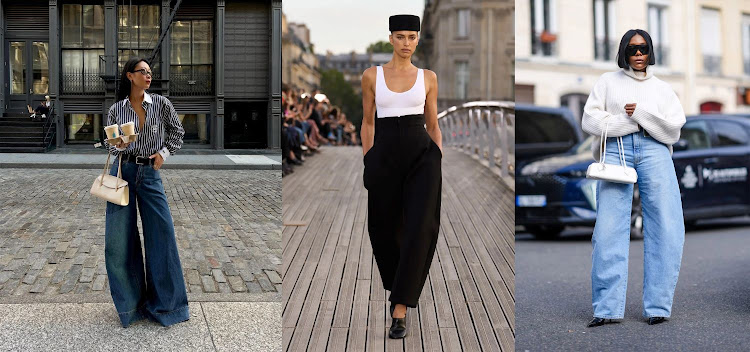
Image: @thecarolinelin; Alaia; Edward Berthelot
After the skinny fit’s almost two decades of dominance, roomier silhouettes are now in style
When it comes to pants, if you are still wearing skinny jeans or tapered fits, I feel obligated to ask the question, “why”? Though, as I write this, I’m sitting in a restaurant surrounded by people in skinny fits, there is also an equal number of people in looser fits — dad jeans or the like, should you need a visual reference.
The skinny jeans — figure hugging, skin tight; and tapered at the ankles — no longer have such a huge grip on the mainstream idea of what we consider “stylish”, or on-trend, and we’re not just writing its obituary in the way we, and other fashion media outlets, have in the recent past. This was largely prompted by TikTok declarations that the skinny jean is dead, and Gen Z’s apparent displeasure with the fit made most popular by the millennial generation before them. Bigger, billowing fits and silhouettes are now firmly at the forefront of culture.
It’s no longer unusual to come across early twenty-somethings in relaxed parachute styles, and for the past at least year or two, brands have obliged by introducing more similar styles. In the second quarter of this year, it was reported that wide leg pants accounted for 50% of Levi’s overall bottoms categories, growing 21% across the iconic denim brand’s distribution channels.
In a blog post on its website, G-Star Raw calls this the “Era of Comfort”, stating, of the skinnies, “the style is not as popular as it once was. Though skinny jeans have made a slight comeback in 2024 with (some) luxury brands including the style in their FW24 collections, the scene has been dominated by roomier fits like the loose, straight and boot cut.”
It’s crazy to think that just a few years ago, the likes of Vogue Magazine — and many fashion scribes like myself — were questioning whether dad jeans could ever be cool again. This was due to the long-running dominance of tight fits across fashion. Right now, as I sit here, judging my fellow restaurant patrons in skinny fits, I can’t help thinking how utterly unstylish they all look. It’s like they were plucked out of a different timeline; one that precedes 2020 and the changes it forced upon us.
Wardrobe mainstay
I first noticed my own discomfort with skinny fits during the lockdowns of the Covid-19 pandemic. Like many others, it was the first time that I came to realise that my closet had almost completely been overtaken by the skinny jeans, making for quite a dilemma when dressing up.
Look, skinny jeans still looked great — especially on my already skinny frame — but I knew then that something had to change because, with nowhere to go, the skinny jeans were objectively uncomfortable. They had become a wardrobe mainstay over about a decade since I left high school, and my entire aesthetic as an adult had been unconsciously designed to fit around them. Covid-19 was a turning point. Much like it was for many aspects of society; fashion trends being no exception.
Across runways, and store rails, ultra skin-tight denim, cropped jackets and the like have given way to volume — tailored bottoms, flowy fits and fabrics, as well as oversized suiting and exaggerated lengths.
Far more than any other article of clothing, pants trends are a definitive timestamp precisely because they don’t change very often. It took centuries, for example, for pants to become acceptable attire for women. Skin fits go as far back as fourth century Europe; what Massachusetts College of Art and Design fashion historian and archivist Doris Domoszlai-Lantner calls “a very early example of what we might now call legging”, per a Guardian article.
More recently, the so-called cigarette jeans became a predecessor of today’s widely known skinny jeans. Icons including James Dean and Elvis Presley wore these before the denim explosion of the 70s. In the 80s, the introduction of stretch fabrics would pave the way for a late 90s, 2000s skinny jean craze that spawned trends such as “indie sleaze”, most iconically embodied by designer Hedi Slimane’s 2003 Dior Homme collection debut.
It’s taken an entire generation, and a few obituaries for the style to finally make way for something new, and I couldn’t be more pleased that after almost two decades of dominance, more comfortable styles are trending. 
Pick n Pay – trading update and statement
Trading update
Trading performance for the Company and its subsidiaries (“the Group”) for the 21-week period to 21 July 2024 (“the Period”) reflected another strong performance from the Boxer segment, while the Pick n Pay segment’s refreshed management team began to execute on the turnaround plan. Given that the majority of the Pick n Pay segment’s new management team has only been in place since March 2024, the Group is encouraged by the initial progress made, while acknowledging the magnitude of the multi-year journey to return this segment to profitability.
Trading statement
The Group advised shareholders that it expects earnings per share (EPS), headline earnings per share (HEPS), and comparable HEPS for H1 FY25 to decrease by more than 20% when compared to EPS, HEPS and comparable HEPS reported for H1 FY24.
Management does not yet have the required degree of certainty to provide details of the anticipated range for EPS and HEPS for H1 FY25. A further update to this trading statement will be provided once the Group has the required degree of certainty to do so.
The Group’s H1 FY25 results are expected to be released on SENS and ANS on or about 28 October 2024.


Gucci manufactured a pair of jeans named the Gucci Genius Jeans. They sold for a staggering $3,134.
An unlikely person to be associated with the fashion world, Napoleon invented the buttons for sleeves after his soldiers kept wiping their noses on their button-free clothes. Ew!
Doc Martens come in all different colors and sizes now, but the first pair was created using old tires.

Editorial Submission:
Please remember to send me your news so that we can share it with all our readers in the weekly newsletter. Although editorial is neither guaranteed nor implied, suitable editorial for consideration may be submitted to:-
