
Newsletter No 31/16 August 2024


NewsBriefs wants to share your company profile.
If you are a manufacturer or supplier to the Clothing & Textile trade please send us your company profile on a word document up to 500 words explaining what your participation is to the industry.
You can also supply one visual in jpeg or png format.
Our aim is to share one newsworthy submission per week with our readers.
Although editorial is neither guaranteed nor implied, suitable editorial for consideration may be submitted to:- carla@newsbriefs.co.za
Click on any ad to go to the advertisers website
Boost credibility with SGS Green Marks’ ‘Product Carbon Footprint’ and ‘Carbon Footprint Reduced’ claim verification

SGS, the world’s leading testing, inspection and certification company, has launched two additions to its SGS Green Marks program: Product Carbon Footprint and Carbon Footprint Reduced.
Product Carbon Footprint (PCF) is an essential measurement of greenhouse gas emission and removal within a product’s life cycle. Brands, manufacturers, suppliers and retailers can now benefit from SGS Green Marks that:
Ensure PCF information is transparent and generated in compliance with the relevant standards and methodologies
Mitigate the risk of greenwashing or reputational damage
Support the accurate communication of environmental performance to stakeholders
Differentiate a product from competitors
Provide global recognition that claims are verified by SGS
For a product to qualify for SGS Green Marks, organizations must first submit a PCF calculation report. SGS then undertakes a rigorous assessment of the PCF following the ISO 14064-3 verification process. This confirms that the PCF was prepared in accordance with either the international standard ISO 14067:2018, or the product standard issued by the Greenhouse Gas Protocol, using a life cycle assessment (LCA) approach.
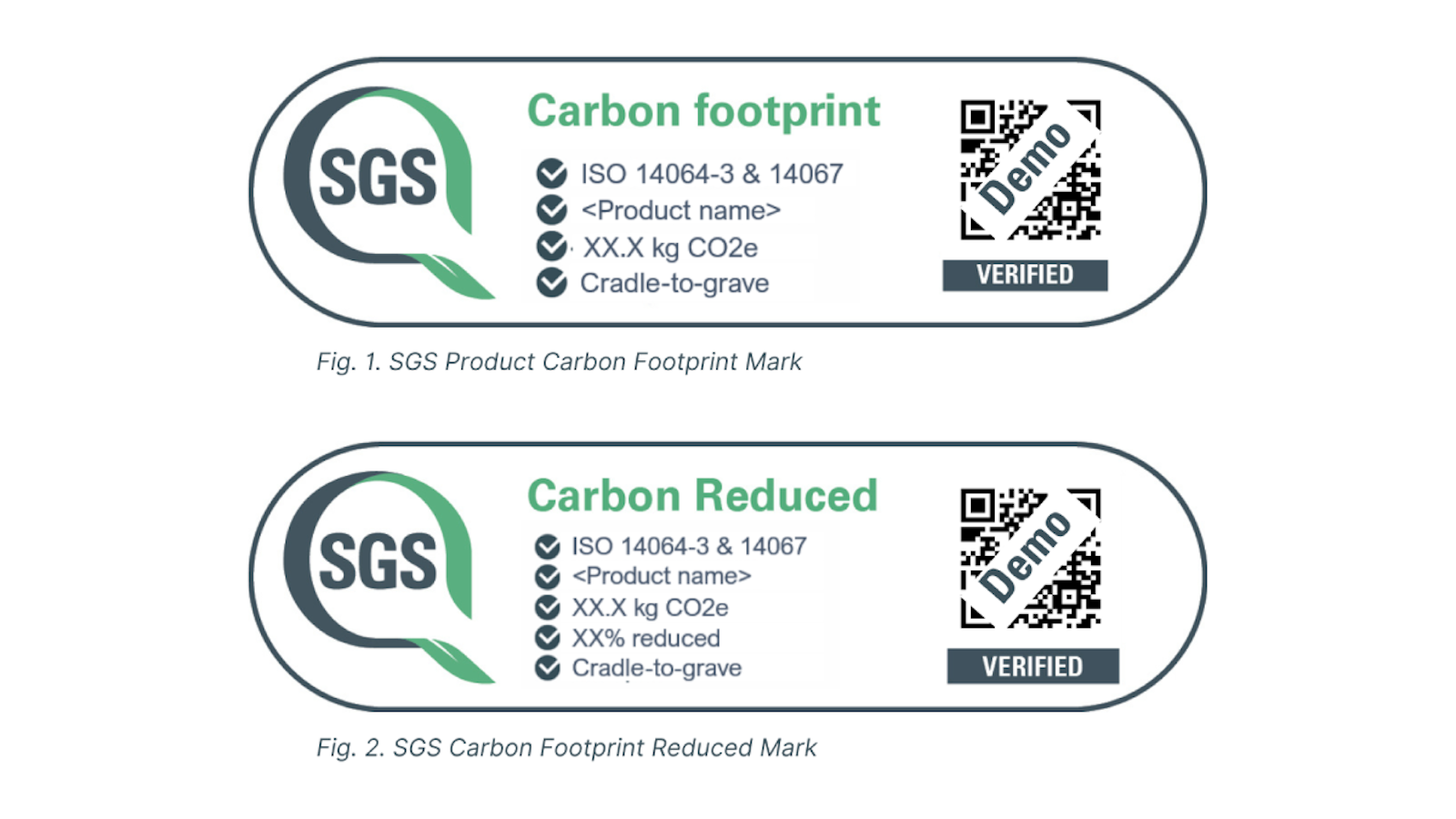
This mark provides details of the product’s environmental claim and assessment standard(s) and displays a QR code that links directly to further information on the claim’s authenticity.
Keith Hutchinson, Deputy Head, Connectivity & Products Global Certification at SGS, said: “We are delighted to extend our portfolio of sustainability services to embrace product carbon footprint and provide the market with a credible way to exhibit third-party verified PCF studies.
“Making claims is easy, substantiating them is not. SGS Green Marks enable organizations to demonstrate a product’s environmental attributes. Ultimately, it enables a growing tide of environmentally conscious consumers to be better informed on the impacts of their purchases and to make greener choices.”
SGS Green Marks
SGS Green Marks, developed by SGS experts, now comprises nine individual green attribute certifications or verifications, making this scheme one of the most diverse sets of environmental claim certifications and verifications on the market. The scheme supports businesses and brands striving to enhance their sustainability effort and respond to rising consumer demands for greener products and services.
Based on recognized standards such as ISO/IEC 17065, ISO/IEC 17029, ISO 14065 and ISO 14021, SGS Green Marks verify that products have passed a range of assessments to meet specific and quantifiable environmental attributes and claims under the following nine environmental attributes:
Learn more about SGS Green Marks

Changes to Customs import system

Tshwane, 8 August 2024 – The South African Revenue Service (SARS) remains committed to providing clarity and certainty in the implementation of its mandate of promoting legitimate trade for the economic development of the country in an era of rapidly expanding e-Commerce. This will be achieved by making it simple and easy to facilitate an increased movement of goods.
Pursuant to the above mandate, SARS noted legitimate concerns that have been expressed in the importation of several of goods, especially clothing, via e-Commerce by a number of importers who have not been paying the obligatory Customs duties and VAT on these imports, resulting in unfair competition with other industry players.
The concerns stem from the fact that, due to the immense scale of trade via e-Commerce, SARS Customs implemented a “concession” for goods valued at less than R500, in terms of which importers paid a flat rate of 20% in lieu of Customs duties and no VAT.
To address these concerns and to provide clarity for traders involved in the importation of goods via e-Commerce, SARS will make several changes in line with the World Customs Organization (WCO) framework to deal with the already changing trade landscape.
In early 1990 the shipment of large numbers of small or negligible value goods across borders being carried by courier and express mail services was already experiencing significant growth globally and resulted in the World Customs Organisation (WCO) developing a set of release/clearance procedures – known as the “WCO Guidelines on Immediate Release”.
These guidelines aimed to assist WCO member Customs administrations in standardising the processing of eCommerce goods, based on the principle of information being provided by the operator to Customs in advance of the arrival of the goods, and the universal categorization of goods in four (4) distinct categories: –
Category 1 – Correspondence and documents – No commercial value, not subjected to duties and taxes, immediate release on the basis of a consolidated declaration that may be oral or written (a manifest, a waybill or an inventory of such items).
Category 2 – Low value consignments below a specified de minimis threshold for which no duties and taxes are collected, and immediate clearance and release against a manifest, a waybill, a house waybill, a cargo declaration, or an inventory of items.
Category 3 – Low value dutiable consignments (simplified goods declaration) – goods above de minimis, but below full declaration value threshold, dutiable, and the use of a simplified declaration, or release against a manifest with subsequent simplified clearance, etc.
Category 4 – High value consignments (full goods declaration) – Consignments not falling under the three categories described above and includes consignments containing goods that are subject to restrictions. Normal release and clearance procedures, including payment of duties and taxes, apply.
The changes to be implemented:
• The introduction of VAT in addition to the current 20% flat rate Customs duty by 1 September 2024 as an immediate interim measure.
• The reconfiguration of the current 20% flat rate into the WCO regime for the first 3 broadband categories with appropriate duty rates, by 1 November 2024.
SARS Commissioner Edward Kieswetter said SARS will partner with the Department of Trade, Industry and Competition (DTIC), as the custodian of the country’s trade policy and development, as well as other industry players, to build public trust by seeking opportunities to level the playing field to protect local industries and create business opportunities for economic growth. He said that SARS will resort to “the greater use of data, artificial intelligence, machine learning and algorithms to better facilitate trade while minimising risks to the economy”.
For further information, please contact SARS at SARSMedia@sars.gov.za
H&M and Anamika Khanna embrace Indian culture in new collection

H&M’s Ann-Sofie Johansson with Anamika Khanna. Image supplied
H&M has unveiled a new collection with celebrated Indian fashion designer Anamika Khanna. The collection reveals the Kolkata-based designer’s signature eclecticism and flair for fusing glamour and opulent craftsmanship with contemporary tailoring and luxe loungewear.
Since launching her eponymous brand in 1998, Anamika Khanna has been a driving influence in modernising Indian fashion and translating the country’s rich craft traditions to the wider world – a dynamic approach that underpins this bold new collaboration.
Alive with vivid colour, pattern and hand-embroidered embellishment, the collection is replete with fluid and flattering, highly versatile styles – adapted to daywear and nights out.
Under Khanna’s direction, even the most show-stopping looks come instilled with a laid-back, loungy attitude, with everything conceived for comfort — from the light, flowing skirts, capes and dresses to the street-smart suiting and sportier styles.
Inspired to bring the sartorial codes of India to an international customer, Khanna reimagines traditional cuts such as kurta pyjamas, kaftans and lungi skirts with a fresh and contemporary allure.


Images Supplied
“Anamika was the first female Indian designer to take part in Paris Fashion Week. Her style is an interesting mix of the Indian tradition of bridalwear with modern touches, such as sportswear. And she is a master of contrasts, mixing feminine and masculine codes to create something entirely new,” says Ann-Sofie Johansson, creative advisor at H&M.
The collection, which comprises womenswear, jewellery and accessories, will be available in South Africa at Gateway in Durban and online from Superbalist from 5 September. Bizcommunity


Queen Juana, from Portugal, wore the first hoop skirt in a bid to hide the fact she was pregnant.
In the Middle Ages, poorer people would wear mittens, while the richer would wore gloves to show off their wealth.
You can’t go out these days without seeing a shopping center, thanks to the ancient Romans who built the very first one.
Company profile:-
Imaterial Textile Printers – your Local Fabric Printing Partner since 1986

At Imaterial we strive to produce excellent quality textile prints for all our customers – offering the convenience of being one of the few locally accessible natural fabric rotary and digital printers in Cape Town, South Africa. r
Thanks to our experienced staff and local customer support, Imaterial continues to grow after 38 years of specialised pigment printing for the South African textile industry.
Our competitive pricing, versatility, responsiveness, up to date technology and quality workmanship make us the best viable alternative to imported printed textile suppliers.

Editorial Submission:
Please remember to send me your news so that we can share it with all our readers in the weekly newsletter. Although editorial is neither guaranteed nor implied, suitable editorial for consideration may be submitted to:-
