
Newsletter No 28 /1 August 2025

Click on any ad to go to the advertisers website

To agents, manufacturers, distributors & wholesalers. Please upgrade your 1 line listing to a business listing at least. The Sourcing Directory and Newsletter is dependent on industry support and your business listing offers potential clients more information about your company, products, branches, agents etc.
The cost of a business listing for the entire year is only R1400.
To add a logo is an additional R440. carla@newsbriefs.co.za


The purple people changing the fortunes of a rural town
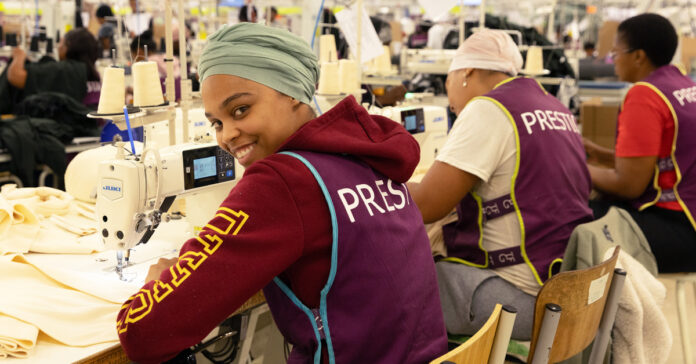
The once-sleepy Overberg town of Caledon has experienced a purple-hued revival as young job seekers join the TFG Prestige clothing factory’s learnership programme in their hundreds, demonstrating this Youth Day that the future of rural South African youth could be in clothing.
From humble beginnings in 2008 starting as a privately owned company with eight workers operating in a modest factory, the Prestige Clothing factory in Caledon has expanded rapidly over the past 17 years to become the biggest employer in town. This growth was accelerated after being acquired by TFG in 2012 with a major milestone being achieved in 2016 when TFG built a state-of-the-art greenfield factory ensuring Prestige Caledon was housed in a world-class facility ready for future growth.
The factory has absorbed so much of the town’s available skills that it has begun recruiting from other towns in the Overberg region and as far afield as the coastal town of Hermanus, subsidising transport so that the 400 or so workers who commute daily can do so affordably.
TFG is a major driver of youth employment and skills development. With an investment of R150-million in youth development programmes in the past financial year, TFG has created over 2 700 youth workplace opportunities through Learnerships, Apprenticeships and Internship as well as through the YES initiative across its factories, stores and Head Office.
“We are dedicated to strengthening the local industry and nurturing the next generation of leaders in the textile and manufacturing sector. This commitment lies at the heart of our strategy for building a sustainable business and reflects our deep responsibility to the communities we serve,” says TFG CEO, Anthony Thunström.
In batches from 30 to 60 per cohort, and at a rate of 300 a year, TFG provides learnerships to school leavers and previously unemployed youth to equip them with the skills required to work on a modern clothing production line. At almost 900 workers today, and still growing, the workforce has been built entirely on learnerships, with classes hosted on site as well as the local community hall and at the golf club next door to the factory.
The students start with eight weeks of classroom and initial practical training in a controlled classroom environment before progressing to the factory floor for the remainder of their practical training. Sensitisation to the factory environment is provided for, every Friday in the early stages of their practical training where they are able to refine their skills alongside their future colleagues on the factory floor. Once they have successfully completed their twelve-month learnership, they are awarded with an NQF level-2 qualification with opportunities to further advance their training in Work Integrated Learning and then full-time employment at TFG Prestige Clothing.
Supporting South Africa’s localisation strategy for investment and job creation, TFG’s Prestige Clothing factory equips South African youth with a national qualification and exposure to world-class manufacturing technology and methodologies training them with modern machinery and manufacturing methodology – all within a compliant, industry leading factory environment.
TFG sources 81.6% of clothing locally – within South Africa and the SADC region, and Caledon is just one part of TFG’s broader manufacturing footprint, which now employs close to 5 000 people across the country in owned facilities.
The Caledon factory has the capacity to produce over 4 million garments a year and has recently expanded the range of items made there to include dresses and skirts, whilst continuing its supply of t-shirts and fashion fleece to TFG’s Sportscene brand.
“Ultimately, the Caledon factory supports our quick response model, which relies on local production to allow TFG brands to adapt their lines to market trends at speed, instead of placing an order and then waiting weeks for goods from Asia.
“This minimises overproduction and attracts lower mark-downs on products, contributing to better margins and less waste,” says Jacquii Moriarty, TFG’s head of design and manufacturing.
But, none of the company’s brands are obliged to buy from its factories – they all have to compete on an equal footing with other suppliers in the market. That means the young people in the learnership programme must meet the world-class standards expected of any supplier – showing what is possible for South Africa’s clothing industry with the right investment and training.
Today the factory’s small army of purple-apron clad employees is a familiar sight in Caledon each morning and afternoon as they make their way to and from work, and on Friday afternoons when they finish early to do their weekly shopping. This regular injection of money into the local economy has been a boost for businesses in the town, spreading the economic benefits of the factory throughout the community.
Cape Business News

Lesley-Anne Dean appointed as country manager for Cotton On South Africa

Lesley-Anne Dean
A leader led by purpose, people and performance
The Cotton On business, a leading fashion retailer spanning multiple fashion and lifestyle brands, is proud to announce the appointment of Lesley-Anne Dean as the new country manager for South Africa, effective immediately. With more than 20 years of retail leadership experience, Dean steps into the role at a pivotal time, as the organisation celebrates its strongest performance in history and continues its commitment to people, purpose and innovation.
Promoted from within the Cotton On business, Dean is a homegrown, seasoned executive who embodies the culture, values and momentum of the brand. Her experience in retail leadership includes senior roles across Clicks, Nike, Superbalist.com and The Foschini Group, where she built high-performing teams, drove significant growth and embedded purpose into the business journey.
Together with her team, Dean is poised to lead the organisation into an exciting new era of growth and impact. With over 135 stores across five beloved brands and a booming e-commerce platform in South Africa, the company is more connected than ever to local customers.
Dean’s appointment also marks an important step in Cotton On’s ongoing mission to build a better future through its people and platform, as these are areas that she is particularly passionate about. Locally, the Cotton On Foundation supports literacy development and school transformation projects in under-resourced communities, the group has invested over R100m in South Africa alone, while globally, foundation has impacted over 200,000 young lives through education and health initiatives.
“This is an exciting time for us, not just in terms of business performance, but in the way we’re showing up for our people, our communities, and our customers,” says Dean. “We have an opportunity to set the tone for the future of retail in our country: inclusive, purpose-led and powered by an incredible generation of young South Africans. That’s what excites me most about my new role.”
“Lesley-Anne’s enthusiasm for people, her belief in the power of purpose-led business, and her deep connection to the South African retail landscape made her the clear choice to lead Cotton On South Africa into its next chapter,” says Michael Hardwick, Cotton On group chief financial officer. “Her leadership is rooted in strategic clarity, deep people insight, and a sharp understanding of customer needs, a combination that reflects Cotton On’s ability to scale bold ideas while staying grounded in what matters most,” he added.

Lesotho battles to avert 50% Trump tariff calamity
By Khulekani Magubane
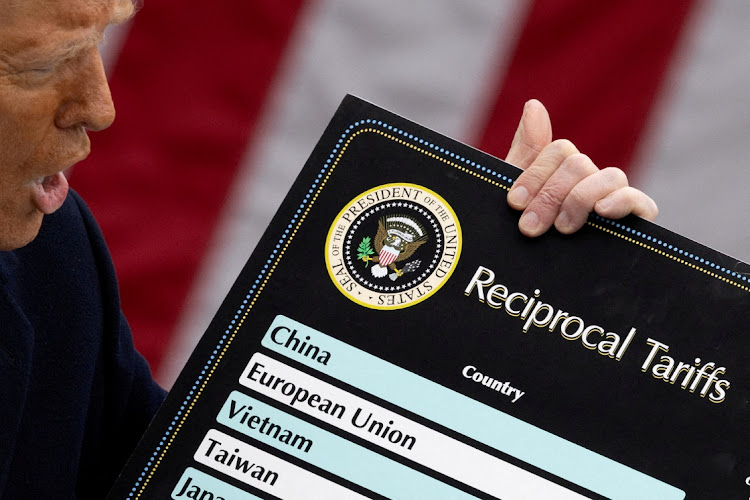
US President Donald Trump in April announced 30% “reciprocal” tariffs on South Africa and other African countries, only to suspend them for 90 days until August. Picture: Reuters/Carlos Barria
Lesotho is engaging with the Trump administration in the hope of clinching a last-minute trade deal to avert what would be a catastrophic 50% tariff on its exports to the US, due to begin this Friday.
Lesotho’s minister of trade, industry & small business, Mokhethi Shelile, told Business Times that the mountain kingdom, which exports about $228m (about R4bn) worth of goods to the US, was still engaging with the administration of President Donald Trump in an attempt to avoid or reduce the tariffs, which could decimate its small economy.
“We are waiting for a response from US trade representative Jamieson Greer for the tariffs that will be applicable for Lesotho,” Shelile said. “We have been informed that there will be a sub-Saharan African tariff that will apply to all countries in the region, except for the big economies.”
Lesotho declared a national state of disaster over its high youth unemployment and job losses as uncertainty over the tariffs hit the landlocked nation. Its annual GDP of about $2bn is highly reliant on exports, mostly of textiles, to the US. It has 11 factories that export clothing, predominantly denim, to the US and provide 12,000 jobs.
Shelile said they were waiting on the Trump administration after his government’s counter-offer. He would not divulge details of the offer. “We have been engaging in trade offers. We got an offer from them, and we sent something back. They asked us to explain some details and we gave them all the information.”
In April Trump announced 30% “reciprocal” tariffs on South Africa and other African countries, only to suspend them for 90 days until August.
Shelile said the tariffs had the effect of nullifying the benefits of the African Growth and Opportunity Act (Agoa), which allows certain exports from sub-Saharan African countries to enter the US market duty-free.
His country was now speeding up efforts to diversify its export markets, he said. “At this point, the Southern African Customs Union, which includes South Africa, Namibia, Eswatini and Botswana, is the primary and most logical market to go for. We have been doing that since June last year, simply because the US market was beginning to show itself to be problematic for our producers. It takes a long time to get materials from China, process them here and ship them to the US, which can take six months.”
Lesotho was also looking at participating in the African Continental Free Trade Agreement (AfCFTA) and was sending goods to the burgeoning consumer market in Nigeria, though this would require considerable investment in network and logistics infrastructure development between African regions, Shelile said.
“We are now starting discussions and negotiations with Nigeria to see if we can ship goods there. It looks a much more promising market. I think we will be able to take things to Durban and then get some cargo ships to Lagos.”
He said Maseru was in discussion with the EU to agree on access to that market. Officials from the UK have already visited to discuss selling Lesotho-made products there.
South Africa is also waiting for a template from the US trade representative, as it too seeks to clinch a last-minute trade deal. Its critical exports to the US, including vehicles, citrus products and wine, are at risk due to Trump’s proposed 30% tariff.
Addressing the National Council of Provinces in parliament on Thursday, trade, industry & competition minister Parks Tau said protectionist trade policies from the Global North presented challenges, but South Africa was engaging with the US for a solution.
“We have been tirelessly working with our US counterparts,” Tau said. “Having submitted our framework deal, we have signed a condition precedent document, a precursor to the finalisation of our trade negotiations with the US.
“Our collective work, which includes business, organised labour and civil society in engaging the US Congress, is also a key lever in our approach for ensuring the continued inclusion of South Africa in Agoa, and to respond to the recently proposed US-South Africa Bilateral Relations Review Act.”
Tau told parliament in a written reply that the framework deal South Africa had submitted to the US constituted a proposal that would be subject to negotiations. “The framework agreement covered, among other elements, the procurement of US products such as liquefied natural gas (LNG), complemented with US investment in gas infrastructure in South Africa and co-operation in key technologies to unlock production of gas in South Africa,” he said.
“[It includes] addressing agricultural market access for both countries, promoting two-way investment and improving the investment climate. Areas of future co-operation [include] tariffs, digital trade and critical minerals.”
On the sidelines of the launch of the BMW X3 plug-in hybrid vehicle in Pretoria, President Cyril Ramaphosa told reporters the government would continue to engage with the US on ideas and proposals for a trade framework that could be approved and formalised “in the coming days”.
Trade, industry & competition spokesperson Kaamil Alli said the department’s team was negotiating with the US in an attempt to avert the tariff deadline coming into effect.
“We are working on a number of fronts, trying to negotiate in the areas of interest to the US while preserving our interests,” Alli said. “Our framework deal did include procuring LNG from the US … We have not received substantive feedback on the framework deal.
“The minister and the department have been working towards a greater diversification of our export trading partners. This includes export and investment drives with a number of countries, including countries in the EU like Germany and France, and Japan and China.” 


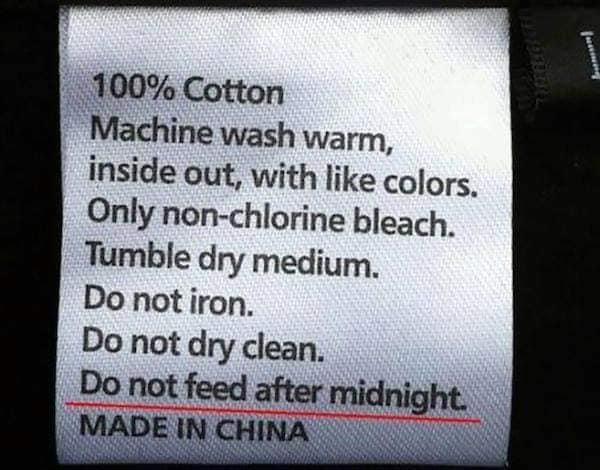
Obscure text additions sometimes added to clothing labels. Apparently, there can be secret messages too!

Editorial Submission:
Please remember to send me your news so that we can share it with all our readers in the weekly newsletter. Although editorial is neither guaranteed nor implied, suitable editorial for consideration may be submitted to:-
