
Newsletter No 25 /11 July 2025

Click on any ad to go to the advertisers website

To agents, manufacturers, distributors & wholesalers. Please upgrade your 1 line listing to a business listing at least. The Sourcing Directory and Newsletter is dependent on industry support and your business listing offers potential clients more information about your company, products, branches, agents etc.
The cost of a business listing for the entire year is only R1400.
To add a logo is an additional R440. carla@newsbriefs.co.za


Sactwu acquires three properties from HCI in R550m deal
by Jacqueline Mackenzie

Picture: 123RF/Solarseven
HCI unit Squirewood to also buy 1.1-million HCI shares owned by the union for R144.1m
Hosken Consolidated Investments’ (HCI) wholly owned subsidiary Squirewood Investments 64 is to buy 1.1-million shares in HCI owned by the Southern African Clothing and Textile Workers’ Union (Sactwu) for R131 per share, or R144.1m in total.
In addition, HCI has concluded a sale of shares and claims agreement against three wholly owned subsidiaries in the HCI group — Gallagher Estate Holdings, HCI Rand Daily Mail and HCI Solly Sachs House — which Sactwu will acquire for R549.7m.
HCI said in a statement that Sactwu had held its interest in HCI since 1997, primarily as an income-generating asset and investment vehicle to benefit union members through investments in media, hotels, casinos, coal mines and transport.
Sactwu holds significant property interests outside its investment in HCI with most of its properties occupied by the union itself.
Sactwu has sought to increase its interests in investment property to generate more regular cash flow to fund its operational and member benefit programmes and employment projects.
Since HCI distributes cash dividends to its shareholders every six months, Sactwu has been disposing of HCI shares on market through the JSE order book to enable it to fund its obligations. As these disposals are not sustainable over a longer period of time, Sactwu engaged HCI to find solutions for its cash flow requirements.
The parties agreed that, given Sactwu’s desire to increase its interests in property, investments in immovable property generating sustainable monthly cashflows was probably the most appropriate asset class for Sactwu to acquire.
HCI granted Sactwu the opportunity to conduct a due diligence of the group’s property assets. Sactwu selected the three properties.
In addition, Squirewood agreed to acquire 1.1-million HCI shares from Sactwu for cash, thereby avoiding the need for further disposals of HCI shares on market through the JSE.
HCI considered the purchase price payable by Squirewood of R131 per share in terms of the transactions, which represented a discount of about 2% to the 30-day volume weighted average price of HCI shares on July 2, to be value accretive to HCI shareholders, it said. 
Soft Power: Fashion’s quiet rebellion against the manosphere
By Sandiso Ngubane
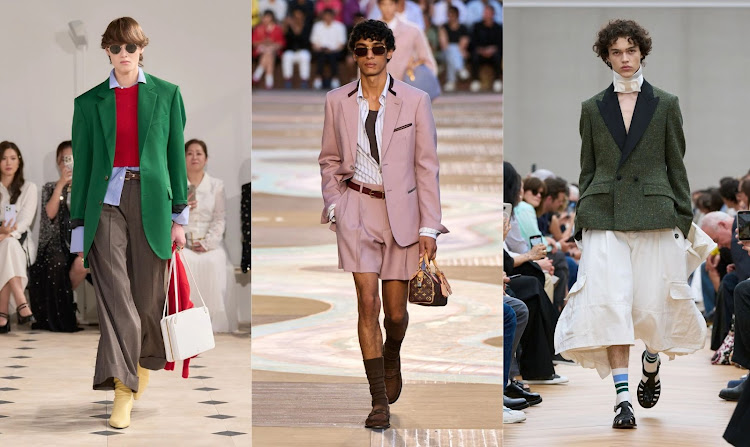
Celine Spring 2026 Ready-to-Wear, Louis Vuitton Spring 2026 Menswear and Dior Men Spring 2026. Image: Isidore Montag/Daniele Obberauch/Fior-Dragone/Gorunway.com
Be reminded that softness is not a synonym for weakness as men’s wear proposes a vibe shift
The recent Paris fashion shows for men revealed a quiet revolution in menswear.
At Louis Vuitton, Pharrell Williams sent models down the runway in Western-fringed leather, delicate lace shirts, and sun-kissed pastels — a cowboy dream softened by romance.
Over at Dior, Jonathan Anderson debuted his first men’s wear collection as creative director, which espoused what L’Officiel has termed a “soft rebellion”— reimagining the masculine silhouette with cravat-inspired collars, embroidered waistcoats, and fluid suiting.
Drawing from 18th-century dandyism, the result was an offering of almost devotional delicacy. And Celine, now under creative lead Michael Rider, revived the preppy wardrobe with a tender, youthful restraint.
In a world where the manosphere thrives on hardness, control and emotional denial, the runways offer a soft power: a vision of masculinity that is expressive, romantic and defiantly vulnerable.
These are aesthetics that go beyond “men in skirts” surface-level gender play familiar to fashion week. It’s an embrace of sensual textures, draping, lace, pastels and softness that resists the need to perform masculinity at all.
In direct contrast to the aggressive discourse igniting gender wars online and the rise of “the loneliness epidemic”.
It was barely eight months ago that Donald Trump delivered an upset, defeating Kamala Harris in the US presidential election, in a campaign Associated Press described as “dominated by masculine appeal.”
Meanwhile, a UK Netflix series titled Adolescence sparked a global conversation by tackling how young men can be drawn into toxic masculinity, and “incel” ideology perpetuated by online radicalisation. It exposed a culture-wide crisis of masculinity that few seem to have solutions for.
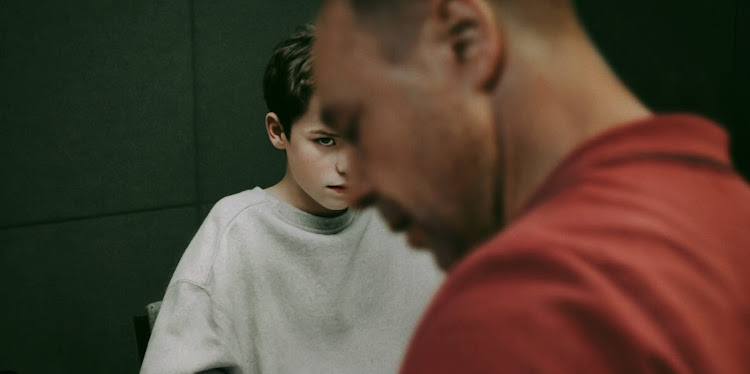
The Netflix TV series “Adolescence” addresses themes of online radicalization and toxic masculinity. Image: Netflix
Here in SA, the crisis is evident in a stubborn trend of femicide that has received global attention. Fashion’s response has not been to meet this aggression with a harder edge, but rather to propose softness as strength, beauty as resistance.
While politicians posture and influencers peddle alpha-male archetypes, fashion imagines an alternative: that tenderness, nuance and vulnerability can coexist with power. The flowing blouses, pastel palettes and satin suiting seen on Paris runways are not mere decoration, they are acts of cultural defiance. They remind us that masculinity can, and must, evolve.
This evolution is not without friction. Much of the reactionary energy found in the manosphere is precisely that — reactionary. It is, in part, a backlash to shifting gender norms, a refusal to accept that the old archetypes of dominance, stoicism and brute strength are no longer the only scripts available to men.
Online, entire communities have formed around a sense of loss and confusion, leading many young men to seek identity in regressive forms of masculinity. But if fashion is often ahead of the cultural curve, it may also offer one of the few tangible blueprints for reimagining what masculinity looks and feels like in the 21st century.
By romanticising softness and embracing vulnerability, men’s wear designers are not simply staging an aesthetic intervention, they are participating in a broader cultural conversation. Their garments challenge the presumed weakness of emotion, refusing to accept that care, beauty and introspection are traits to be mocked or suppressed. A lace shirt or a draped coat becomes not just a fashion statement, but a subtle confrontation of societal expectations.
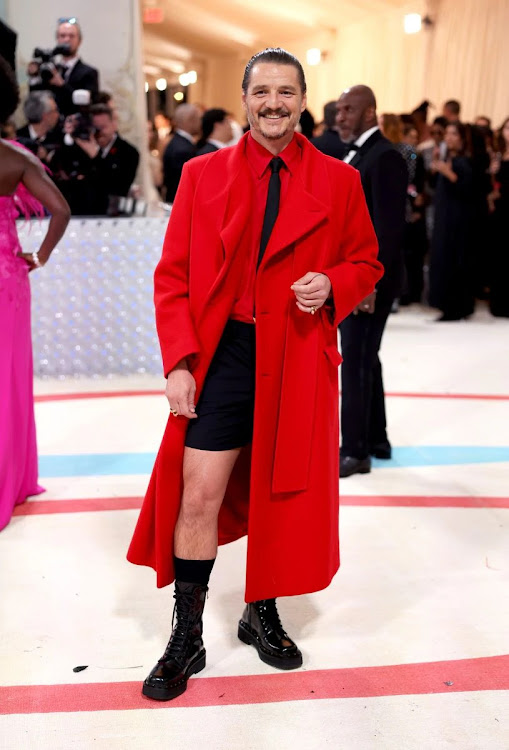
Pedro Pascal attends The 2023 Met Gala in Saint Laurent. Image: John Shearer
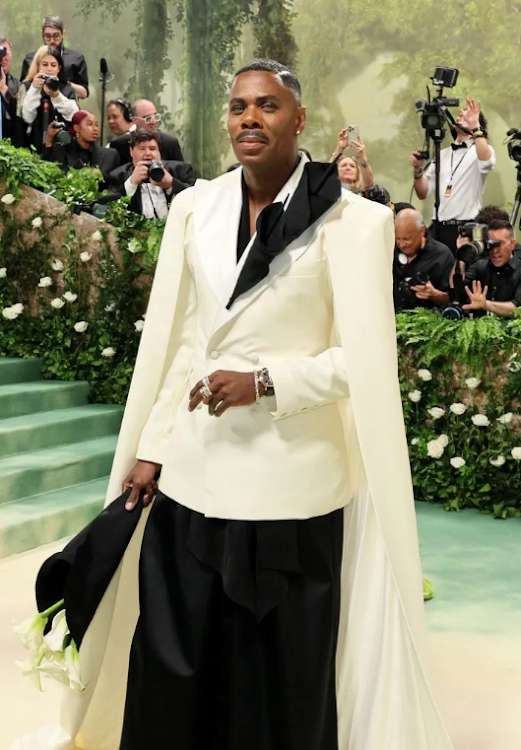
Colman Domingo wore a large-lapeled white tuxedo jacket with a matching cape by Willy Chavarria to the 2024 Met Gala. Image: Dia Dipasupil/Getty Images
Moreover, this shift is not limited to high fashion. On red carpets, in editorials and increasingly in streetwear, we are seeing silhouettes loosen, colour palettes soften, and self-expression expand.
This shift is also reflected in the rise of Hollywood figures like Pedro Pascal and Colman Domingo, both of whom have embraced fashion as a form of emotional and aesthetic expression
Pascal, with his fondness for soft knits, pastels, and gender-fluid silhouettes, has become something of a heart-throb not just for his acting but for his unapologetic tenderness. Domingo, often clad in bold tailoring and luxurious fabrics, brings a sense of theatricality and grace to men’s wear that challenges rigid ideas of black masculinity in particular.
Beyond the red carpet, perhaps even more powerfully, are the public figures, especially fathers, who are rejecting the script of traditional masculinity by standing beside their transgender children.
Dwayne Wade, the former basketball player and spouse to actress Gabrielle Union, has been vocal and visibly present in affirming his daughter Zaya’s gender identity. He has used his platform to model a new form of fatherhood grounded in empathy, openness and protection.
Marlon Wayans has spoken openly, often exposing himself to online ridicule, over his journey to accepting his transgender son, Kai. These examples suggest that the cultural conversation around masculinity is shifting not only in the realm of aesthetics but in the realm of values: what it means to be a man, a father, a public figure.
Fashion, as ever, is both a mirror and a map. It reflects the contradictions of the moment but also gestures towards what could be.
This embrace of softness, fluidity, and emotional honesty may seem small, but it matters. It suggests a growing appetite, among some men, at least, for release from the pressures of performance masculinity.
In this moment of global cultural anxiety, fashion reminds us that softness is not a synonym for weakness. 

Lesotho reels as tariff uncertainty causes order cancellations, mass lay-offs
by Marafaele Mohloboli and Siyabonga Sishi
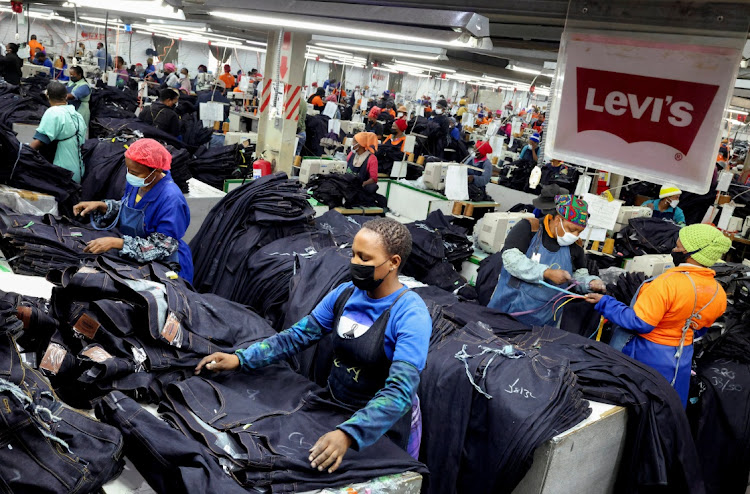
Workers perfom their duties at the Nien Hsing Textile factory, a global manufacturer of jeans, on the outskirts of Maseru, the capital of Lesotho. File photo: Reuters/Siphiwe Sibeko
Lesotho declares a national state of disaster due to the ‘high rates of youth unemployment and job losses’ caused by uncertainty surrounding the tariffs
When Limpho Lefalatsa first learnt she had lost her job at a Lesotho garment factory after 12 years due to US President Donald Trump’s decision to hit her tiny African homeland with a crippling tariff on its exports, she was in shock.
“I thought I was going insane. It made no sense,” the 29-year-old said at her house in the capital Maseru. “When the truth started sinking in, I felt so helpless.”
Lefalatsa’s monthly factory wage of about R3,000 ($168) had supported herself, sent her 12-year-old daughter to school and paid for the blood pressure medicine her elderly grandmother needs to survive.
Now that income is gone, and she still does not understand why. She’s not alone.
When Trump announced tariffs on imports for nearly all of the US’s trading partners in April, the Southern African mountain kingdom of Lesotho was singled out for the highest rate: 50%.
Lesotho officials were baffled, not least since their country, which Trump disparaged as a nation “nobody has ever heard of”, was the poster child of a flagship US programme aimed at helping poor African economies develop through trade.
The Trump administration has defended the tariffs as reciprocal, saying that Lesotho charges 99% tariffs on US goods. Lesotho officials say they do not know how the White House arrived at that figure.
The US state department did not immediately respond to a written request for comment.
Lesotho’s textiles sector, its leading export industry, is heavily dependent on the Africa Growth and Opportunities Act, a US trade initiative that offers qualifying African nations duty-free access to the US market.
On the back of that preferential tariff treatment, Lesotho developed a textiles sector that, until now, was the biggest private employer with some 40,000 jobs and accounted for roughly 90% of manufacturing exports, according to Oxford Economics.
Exports to the US under Agoa, including Levi and Wrangler jeans from a textile sector that largely employs women like Lefalatsa, make up a tenth of Lesotho’s $2bn GDP.
That now looks set to disappear.
This week Lesotho declared a national state of disaster due to the “high rates of youth unemployment and job losses” caused by uncertainty surrounding the tariffs.
“You can see there are no people here,” said Teboho Kobeli, owner of Afri-Expo, which makes jeans for export, gesturing towards rows of unmanned sewing machines at his factory.
While Trump suspended application of his tariff barrage for three months just days after his “Liberation Day” announcement to give trading partners time to negotiate deals with Washington, in Lesotho the damage was already done.
The simple prospect of a 50% tariff caused many US importers to cancel orders, leading, in turn, to mass sector-wide layoffs. And what orders still exist now bear more risk than reward.
“Employers are just scared of taking more orders lest they plunge themselves into costs they are not ready to service,” independent political and economic analyst Lefu Thaela told Reuters.
The White House has yet to announce its final tariff on imports from Lesotho. Trump’s 90-day suspension was due to expire on Wednesday. But factory owners like Kobeli, who has dismissed 200 workers from his US-focused production lines, fear the worst.
“If we still have these high tariffs, it means we must forget about producing for the US and go as fast as we can (looking for) other available markets,” he said.
A spokesperson for Lesotho’s trade ministry declined to comment until the government receives official communication from the Trump administration.
However, others, like retrenched garment worker Nteboheleng Hlapane, have a message for the US president.
“I just pray to God that he touches your soul,” said the 37-year-old, who can no longer afford the inhaler her son needs to treat his asthma. “Think about other people. They are suffering because of your selfishness, your cruelty.” Reuters
Classifieds:-
Enin cc 083 600 4293
We are seeking experienced and passionate agents to represent our high-quality denim/twill fabrics in key markets across Africa.


Fascinating Facts about Fashion & Clothing
The handbag was first designed and used to help women attract a husband. It was invented in the 19th Women would embroider them with intricate and colorful patterns to show off to the men.

Editorial Submission:
Please remember to send me your news so that we can share it with all our readers in the weekly newsletter. Although editorial is neither guaranteed nor implied, suitable editorial for consideration may be submitted to:-
