
Newsletter No 22/14 June 2024


NewsBriefs wants to share your company profile.
If you are a manufacturer or supplier to the Clothing & Textile trade please send us your company profile on a word document up to 500 words explaining what your participation is to the industry.
You can also supply one visual in jpeg or png format.
Our aim is to share one newsworthy submission per week with our readers.
Although editorial is neither guaranteed nor implied, suitable editorial for consideration may be submitted to:- carla@newsbriefs.co.za
Click on any ad to go to the advertisers website

Code green
By Nokubonga Thusi
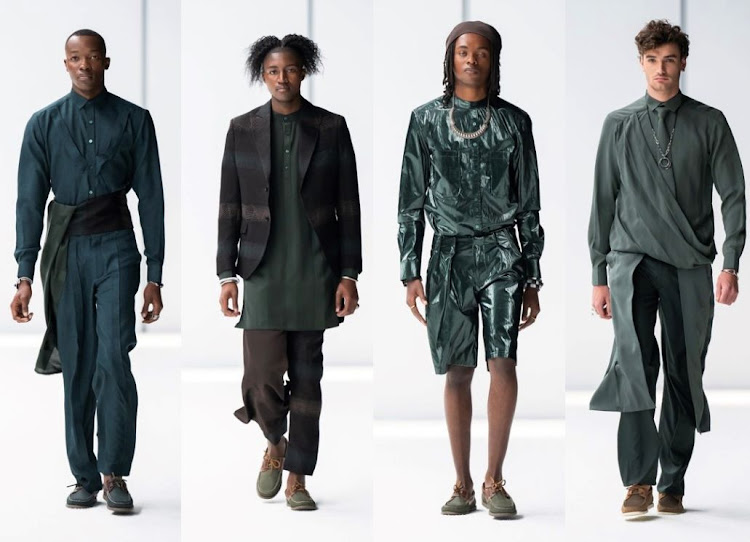
Ephymol Spring/Summer 2024 collection Image: Eunice Driver for SA Fashion Week
Ephymol’s latest collection is a symbol of rebirth
Ephymol’s recent collection, shown at SA Fashion Week, gave the green light to the hue du jour. Taking inspiration from the Prince era, the collection was an artful display of tailoring prowess, Middle Eastern-inspired draping, and shades of green as a symbol of rebirth. “This season, suit pants are wider and jackets are boxy silhouettes with longer lengths. Think double-breasted jackets with wide lapels, really going back to that Miami Vice look and feel of the 1980s. We’re also doing collarless jackets that don’t have a lapel, creating more of a sport-edge look. Suits are more vibrant in terms of fabrics: brocade, gothic suits — there’s more fun, edginess, and playfulness than with your normal grey or brown suit,” said designer, Ephraim Molingoana. 

Hawks nab 7 officials for massive SARS border post fraud

The Directorate for Priority Crime Investigation (DPCI), also known as the Hawks, have pounced on 7 suspects involved in tax fraud more than R650 million.
The suspects, who are former and current SARS customs employees, pretended to have cleared exports from the Durban port to Lesotho.
An investigation found that over 300 textile cargo transactions were cleared, but the consignments were not moved at Ficksburg, Van Rooyenshek and Maseru border posts.
The 4 women and 3 men were nabbed in Limpopo, Gauteng, Free State and Eastern Cape this week.
“These workers have been investigated and found to have intentionally defrauded SARS by pretending or purporting to have cleared exports when in actual fact, that did not happen. Those exports were kept within the country,” said SARS spokesperson Siphithi Sibeko.
“5 of them were found guilty by the disciplinary committee of the South African Revenue Service and dismissed. 2 of those resigned before the matter could be decided.”
“The other 2, 1 was given a warning and others that are remaining, are still to face a disciplinary hearing.” S&V
Orange Corners | Designs Programme: Incubation and Acceleration

A new initiative of the CDI supported by the Ministry of Foreign Affairs of the Netherlands, The Orange Corners | Designs Programme is on the lookout for visionary individuals whose businesses are poised for growth and dedicated to making a positive impact in under-resourced communities to participate as the first (1st) Cape Town cohort of the programme starting in July 2024.
If this describes you, then you might be eligible to apply to participate in the Orange Corners | Designs Programme which will incubate you for a period of 10-12 months undergoing intensive business and mentoring intervention.
Focused on the following industries:
The Craft and Design Institute and Orange Corners Designs are on a mission to revolutionise entrepreneurship! By embracing the power of Design Thinking, we’re growing businesses that not only meet real-world needs but also leave an indelible mark on communities.
Calling all trailblazing entrepreneurs with a vision for change and a heart for impact! Applications are open for our inaugural Cape Town cohort, and we want YOU to be a part of this electrifying journey.
Don’t miss out on the opportunity to join forces with CDI and shape a brighter future together. Apply now!
https://www.thecdi.org.za/page/OCD

TFG delivers a solid performance, taking further market share in a challenging economic environment
Highlights
Revenue up 8,9% to a record R60,1 billion
TFG announced its annual financial results for the year ended 31 March 2024, domonstrating the Group’s continued operating strength despite macro-economic headwinds in all territories
Commenting on the results, TFG CEO, Anthony Thunström said, “I am pleased that the Group was able to deliver a very strong performance in another challenging year. Through our aggressive growth of revenue, at the expense of our competitors, and the effective management of costs, we have delivered compelling positive operating leverage. In many cases, revenues, margins, gross profit and EBIT have been at record levels in Rand terms across all of our territories, demonstrating the strength of our diversified business.”
Delivering operating leverage
TFG Africa’s retail turnover grew by 10,4%, driven largely by clothing, with a particularly strong performance in Sport and Womenswear, as well as Homeware. Following the continued investment in the e-commerce platform, Bash, online retail turnover grew 44,4% and now contributes 4,2% to retail turnover. The business saw a record gross profit of R16,1 billion and record EBIT performance, growing 24,9% to R4,2 billion.
Despite TFG London experiencing continued elevated inflation and interest rates, putting the UK consumer under pressure, it delivered a retail turnover of R7,6 billion up 10,4% (in Rand terms). Gross profit margins were maintained at a record level of 62,1% through careful inventory management and an increase in own-channel mix, delivering a record gross profit of R4,7 billion.
TFG Australia also experienced higher inflation and interest rates, impacting consumer confidence and demand. Set against a strong post-COVID-19 recovery base, revenue was up slightly by 0,2% to a record R9,4 billion (in Rand terms). Online retail turnover grew 7,5%, now contributing 7,3% to TFG Australia’s retail turnover.
Market share gains
In his presentation, Thunström highlighted that TFG Africa had delivered year-long market share gains across all key categories, outpacing competitors across the board. He added, “In a low growth environment, this ability to continue to grow at the expense of competitors is critically important and speaks to the strength of TFG’s unique retail ecosystem.”
Delivering against balance sheet guidance
Earlier in the year, the Group committed to achieving greater working capital efficiency, reducing costs and paying down debt. Through rigorous management of the balance sheet, TFG has exceeded all of those targets. A highlight was the cash generated from operations of R12,5 billion (up 76%) that, in part, drove the decrease in the Group’s net debt by 31,3% to R4,9 billion, reflecting the improved working capital position.
A notable achievement was the efficiency realised in reducing Group inventories by 11,6%, whilst still delivering top-line outperformance.
Actively building out stores
During the year, the Group continued its build-out and optimisation of stores, opening 272 new stores, optimising almost 100 stores through enlargements, revamps, relocations or reductions, and closing 106 unprofitable stores. Thunström added that the Group had managed to increase trading densities by 10% across its more than 3500 Africa stores in the year alone.
Bash: Best online
Bash continued its outstanding growth during the year and Thunström confirmed that breakeven for the e-commerce platform had been brought forward. Bash is now the number one South African fashion and lifestyle app and saw a 45% increase in first time shoppers. Significantly, full price sales increased 63% and multiband sales increased 83%, demonstrating the cross-shop opportunity and power of a single platform for customers to shop the Group’s much-loved brands.
Outlook
“The Group has purposefully strengthened its balance sheet and, given the ongoing tough consumer environment, we see significant opportunity to build out our investment and brands, particularly in the value segment. We will also seek out strategic adjacencies and high-quality acquisitions to bolster our retail portfolio. We are confident in our strategy and are keenly focussed on its execution to capture additional market share from competitors and continue to deliver profitable growth,” concluded Thunström.
Classifieds:-
Job Description

Title: Sales Consultant, Permanent Position
Reports to: Sales Director
Hours: Mon – Thurs 08:30 – 17:00, Fri – 08:30 – 16:00
We are actively seeking a Sales Consultant to join our esteemed team at a leading textile company based in the Northern Suburbs. If you possess a deep understanding of textiles, coupled with exceptional customer engagement skills, we encourage you to apply.
The ideal candidate will:
Key Responsibilities:
If you are eager to take on this exciting opportunity, kindly submit your CV, recent photograph, and salary expectations to accounts@linings.co.za. Please note, if you do not receive a response within one week, your application may not have progressed to the next stage.


30 Fascinating Facts About Jeans & Denim
It is believed that denim was first invented in Genoa, Italy, as far back as the 1500s. It was made for the Italian navy to wear while on duty.
Although the Italians were the first to make it, the material itself came from a French city called Nimes. ‘De Nimes’, which means ‘from Nimes’ in English, gave the material its name.
The word ‘jeans’ comes from the word ‘Genes’, which is the French word for the city of Genoa.
Denim has been around for several hundred years, but in the 1960s, people began to see it as a sign of rebellion among young people. Establishments began refusing entry to people in jeans as they were worried they were part of a protest.
It was first seen in the 16th century, but Levi Strauss was the man who popularised the material in the 1870s. He made clothes for miners and other working-class people since the material was inexpensive.
A grand total of 225 pairs of jeans can be made from just one bale of cotton.
We’re used to seeing blue jeans, but the color is actually created using indigo dye. This was the best color to hide any dirt which got onto the clothing – ideal for miners and sailors.
Each person in America owns an average of 7 pairs of jeans.
While baggy jeans and bootcut jeans were popular in the 50s, 60s, and 70s, lots of people prefer wearing skinny jeans nowadays. These are made by mixing denim with another fabric called elastane, which helps to slightly stretch the material.
Levi Strauss, the creator of the famous brand Levi’s, never wore a pair of his own jeans. He was a wealthy businessman and jeans were made for the poorer people.
Denim jeans weren’t known as ‘jeans’ until the 1950s – before this point, they were referred to more commonly as ‘overalls’.
In 1936, a label was sewn onto an item on clothing for the first time. It was a red flag sewn next to the back pocket of a pair of Levi’s.
Around 7.5 billion feet of denim fabric is produced every single year.
There are many different styles of jeans available now, including bootcut, skinny and straight. Some retailers even allow people to customize their jeans, choosing features such as pocket size, leg length, fit, and style.
Unfortunately, thousands of denim items are manufactured in sweatshops in third-world countries, even though most denim garments are worn by people in the Western world.
May 20th is regarded as the birthday of blue jeans since it was the day when Levi Strauss patented his idea.
Jeans have been featured in several songs by popular artists over the years. Lana Del Rey released a song titled ‘Blue Jeans’ in 2012, and Neil Diamond released ‘Forever in Blue Jeans’ in 1979.
Ripped jeans, also known as distressed jeans, are one of the most popular fashion looks of the early 21st century. While some people break the bank for a nice quality pair of ripped jeans, many people follow YouTube tutorials and do a DIY job.
Every year, around 450 million pairs of jeans are sold in America.
If you’ve ever wondered why the inside of denim garments are white, this is because only the outside (warp) is dyed indigo. The weft (interior) is not dyed.
Some people don’t like ripped jeans, but they do look for a more ‘wore-in’ appearance. Some clothing retailers, such as Calvin Klein, sell jeans with this look. A variety of methods are used to achieve it, including beating the denim with rocks.
Before the 20th century, manufacturers imported indigo from India to create the blue denim look. Artificial dyes were then created, so imported indigo become less common.
The oldest pair of jeans to be discovered was found in 1998 down an old mine. According to the date, they were 115 years old.
The small pocket in the larger pocket of your jeans was originally designed for a pocket watch.
In 2001, George W. Bush decided that staff in the Oval Office were not allowed to wear jeans anymore.
While denim is traditionally blue, there are now many other colors available, including black, red, and green. All these colors are achieved with artificial dyes.
In 1951, popular singer Bing Crosby was refused a hotel room as he was wearing jeans. In response to this, Levi’s designed a denim jacket, especially for him.
One of the common features of Levi’s jeans is orange stitching, which is sometimes seen on their jeans. This was first used to match the copper rivets which were first used on jeans.
Soldiers during World War II would wear jeans when off duty, as they were comfortable and casual and allowed them to worry less about getting dirty.
Yoshida Kogyo Kabushikikaisha is the company that makes 90% of the world’s zippers for jeans. The initials YKK can often be found on the zippers.
Now you know more about denim than the average person, you’ll have many opportunities to impress when you next see a pair of jeans!

Editorial Submission:
Please remember to send me your news so that we can share it with all our readers in the weekly newsletter. Although editorial is neither guaranteed nor implied, suitable editorial for consideration may be submitted to:-
