
Newsletter No 2/24 January 2025

To agents, manufacturers, distributors & wholesalers. Please upgrade your 1 line listing to a business listing at least. The Sourcing Directory and Newsletter is dependent on industry support and your business listing offers potential clients more information about your company, products, branches, agents etc.
The cost of a business listing for the entire year is only R1400.
To add a logo is an additional R440. carla@newsbriefs.co.za


Click on any ad to go to the advertisers website

Pepkor ramps up efforts to capture adult apparel market
by Nompilo Goba

A Pep store in Balfour Mall in Johannesburg. Picture: Waldo Swiegers
The group posted revenue growth of 7.8%, with normalised operating profit rising 9.2%, in the 2024 financial year
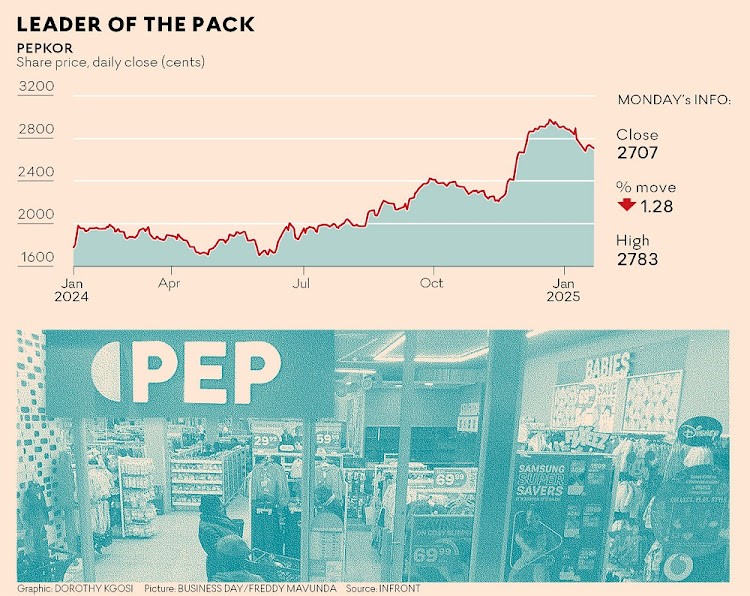
Pep and Ackermans owner Pepkor is ramping up efforts to capture a larger share of SA’s adult apparel market which accounts for most of the country’s clothing sector.
While the group dominates the children’s and babywear categories, it trails behind peers and rivals such as Mr Price, TFG, Truworths and Woolworths who generally do well in this market.
A study by the Retailers’ Liaison Committee shows Pepkor’s commanding position in children’s clothing.
According to the data, the group leads in babywear, childrenswear, and school uniforms, accounting for two-thirds of babywear, half of childrenswear, and three-quarters of schoolwear sales. However, with the adult apparel segment representing 60% of the total market, Pepkor now has a mandate to build customer loyalty beyond childhood.
“The group holds significant market share in SA’s babies’ and children’s apparel categories, representing 27% of the total apparel market. The adult apparel category represents 60% of the total apparel market, with the group’s share of this market being underindexed at low double-digits — a significant opportunity to expand,” Pepkor said in its 2024 annual report.
“In recent years, market share was rapidly expanded in the home category. Our ambition is to cement and strengthen our position in the babies’, children’s, school and home categories and to expand share in the adult market.”
According to Statista, SA’s apparel market is projected to generate $6bn (R112.5bn) in revenue in 2025, with a compound annual growth rate of 5.39% in 2025-29. Women’s apparel is set to dominate, with a market volume of $2.63bn.
Pepkor’s adult apparel segment grew in 2024, supported by record-breaking sales at its speciality clothing brand, Refinery. The brand opened 36 new stores, bringing its total to 154, and launched a children’s line, Refinery Junior. To strengthen its position in the women’s segment, Pepkor said it planned to introduce a new stand-alone retail format in 2025.
The group’s expansion efforts extend beyond SA. In Brazil, its Avenida brand added 42 new stores and a second distribution centre but faced weaker performance due to an unseasonably short winter. Locally, late winter and supply chain challenges, including port congestion in KwaZulu-Natal, affected merchandise availability.
“ [The 2024 financial year] presented the business with a host of complexities. Supply chain disruptions due to port congestion in KwaZulu-Natal affected the availability of merchandise, while the entrance of foreign pure-play online retailers in the local market increased competition in certain product categories. Consumers remained under pressure based on the high cost of living.
“Management responded commendably to [the 2024 financial year’s] challenges. The group expanded its market share in various categories, underscoring our role in clothing families, improving people’s homes and connecting the SA nation,” chair Wendy Luhabe said.
Despite these challenges, Pepkor, Pep and Ackerman’s brands maintained strong sales, and its Lifestyle division expanded its footprint with 54 new stores, bringing the total to 906 outlets.
In the 2024 financial year, Pepkor posted revenue growth of 7.8% to R85bn, with normalised operating profit rising 9.2% to R9.8bn. The clothing and general merchandise segment, which generated R61.4bn in revenue, recorded an operating profit increase of 12% to R7.7bn.
Gross profit margins in this segment expanded to 38.1%, driven by improved full-price sales, the group said.
“The board reviewed and approved the group’s three-year plan to 2027 and the budget for the 2025 financial year. The plan encompasses stimulating strategic initiatives, value-creation plans and capital allocation strategies which will leverage Pepkor’s strong position in the discount and value market to drive growth and create sustainable value for all stakeholders,” Luhabe said.
Pepkor is also eyeing mergers & acquisitions to bolster its portfolio and expand into new categories.
“Pepkor is well positioned to capture additional market share with a robust foundation for continued growth across retail and fintech sectors. Our unique and multifaceted strategy built on purpose-driven growth positions Pepkor to deliver compelling and sustainable growth in the future,” the group said. 

Expanded Agoa offers best chance for real change to African trade development
by Rédha Tir

Illustration: Karen Moolman
With the act set to expire this year, there are questions about nations’ capacity to put up a collective defence of this crucial tool
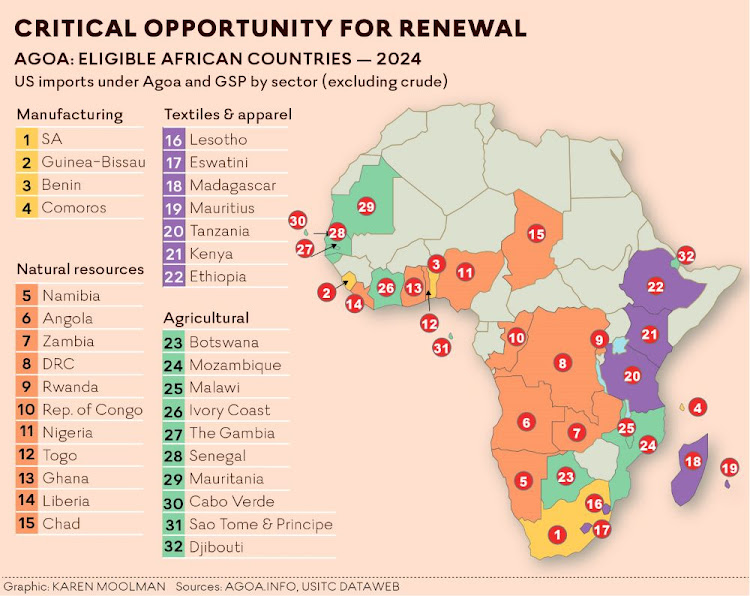
The African Growth and Opportunity Act (Agoa) has, since its passage in 2000, been one of the cornerstones of trade relations between the US and Sub-Saharan Africa. Preferential access to the US market for more than 1,800 products in terms of this legislation has contributed to the African continent’s economic growth, creating hundreds of thousands of jobs in the process in addition to supporting structural reforms of beneficiary countries.
But with Agoa set to expire later this year, a number of questions arise about US strategic priorities and the capacity of African nations to put up a collective defence of this crucial tool. Two dates can be seen as milestones in this determinant period.
The first was the swearing-in of Donald Trump as US president on January 20, which is already altering the course of US policy and economic focus, with trade policy likely to assume a far more transactional tone. In less than a month, a summit of African heads of state will present a critical opportunity to synchronise collective action in the call for the renewal of Agoa. The meeting is of strategic importance to Africa, as long as the need to underline its autonomy and interests vis-à-vis this world power is underlined.
Though Agoa, created by the US to give African products preferential access to the US market, holds immense promise, in reality many constraints have got in its way. Of these, the origin rules under Agoa are considered particularly rigid, especially regarding the clothing industry, which has inhibited the diversification of African exports to the US.
The unilateral nature of this trade regime also created arbitrary eligibility criteria set by the US itself, and has therefore brought with it instability and uncertainty over how long and for whom such tariff advantages apply. The temporary nature of Agoa adds to this uncertainty, discouraging businesses and investors from making long-term investments.
In addition to these constraints there are several other challenges, including high quality requirements, bureaucratic paperwork and visa limitations that affect the development of trade relationships, especially in industries requiring skills and technological transfers. Setting aside these issues, lack of appropriate trade infrastructure, high logistical costs and political or economic instability in several regions of Africa further complicate the continent’s ability to maximise the benefits of Agoa.
However, these challenges can be tempered through such continental initiatives as the African Continental Free Trade Area (AfCFTA), regional customs unions and common markets, to drive regional economic integration. Being one of the flagship projects of the AU, AfCFTA is intended to increase intra-African trade through preferential tariff treatment for 90% of goods over time, thus harmonising trade regimes across the continent.
This will create a wide single market that is conducive to local industrialisation and reduced dependency on exports of raw materials by African countries. A customs union, one of the critical stages of economic integration, entails far more than just eliminating internal tariffs and creating a common external tariff on imports originating from non-African states.
This has a number of benefits, such as reducing the cost of administering trade and simplifying customs procedures for African businesses. However, full implementation of a customs union is not without its challenges, especially in the areas of aligning tariff policies among member states and equitably redistributing customs revenues among countries. A common market allows for free movement of goods, services, capital and people.
The most important strategic opportunity for a real change to trade and economic development in Africa involves the creation of an expanded, improved Agoa to include an all-Africa free-trade arrangement by seamlessly incorporating Agoa into AfCFTA.
Harmonising the two agreements would allow for the development of solid regional value chains, a platform for the acceleration of industrialisation and export diversification, and allow investment stimulation to become a reality through improved competitiveness of African economies.
However, to achieve this, Agoa will require substantial reform so that it moves beyond its unilateral character and provides more equity and sustainability for trade.
Upgrading Agoa to a genuine free-trade agreement for all African countries that are parties to the AfCFTA represents a core interest without any regional or geographical distinction. Such an extension will set in concrete Africa’s trade unity, promote closer regional co-operation, and open integration prospects into the global value chain. A further long-term perspective might be created, one that will be more likely to favour steady investment and a strategic plan as far as economic policy is concerned, with the extension of Agoa’s validity until 2041.
There is also the importance of reassessing Agoa eligibility criteria to avoid unilateral designations of its conditions of access. Agoa could be a true lever for development that is better suited to the realities and priorities of the continent, because it would develop closer participation in decision-making by African countries through harmonisation of standards and policies.
This way, it could ensure real bilateral co-operation through common interests in a sustainable partnership. It thus provides a rare opportunity to make African trade an engine of growth and development, as the reformed and strengthened Agoa would be incorporated into the AfCFTA, then into the customs union and common market.
Refurbishing this relationship with the US must be based on principles of equity, transparency and mutual respect; not only a conquest for Africa but an added value to the global economy. It follows that this agreement must be redefined if it is to become an effective tool for actual economic development on the African continent during the coming decades.
• Prof Tir, a former president of the National Economic, Social and Environmental Council of Algeria, is founder and CEO of Sviews Professional Services. 
Prosper Africa, Afreximbank partner to boost Africa-US trade
By: Schalk Burger
US Agency for International Development private-sector programme Prosper Africa and trade financing company African Export-Import Bank (Afreximbank) have signed a new memorandum of understanding (MoU) to boost trade and investment between the US and Africa in key sectors.
This strategic partnership aims to leverage the strengths of both organisations to mobilise trade opportunities and investment capital, with a focus on creative industries, critical minerals, emerging technologies and textile manufacturing, the organisations said.
Through this partnership, Prosper Africa and Afreximbank seek to advance several shared priority objectives, including scaling trade and use of the African Growth and Opportunity Act (Agoa), creating and upskilling jobs, increasing access to capital, and promoting cultural exchange and collaboration across the US and Africa.
The MoU outlines several key areas of collaboration, including capital access facilitation, technical and transaction advisory support for creative deals, small and medium-sized enterprise (SME) development for agribusiness and textiles, and strategic event collaboration.
An implementation team will be established to ensure satisfactory execution of the terms of the MoU and to review progress periodically, the organisations said.
“Achieving this level of economic growth and impact on people’s lives is not a mission that we can do alone as the US government and is why we partner with African institutions like Afreximbank to achieve these goals,” said Prosper Africa coordinator British A Robinson.
“This collaboration marks a significant step towards strengthening economic ties between the US and Africa, along with the Diaspora. Both organisations look forward to working together to drive growth, create jobs and promote shared prosperity across the continent and in the United States,” she said.
“Our partnership with Prosper Africa signifies a significant milestone in strengthening economic ties between the United States and Africa. By leveraging our combined strengths and expertise, we will unlock new opportunities for trade, investment, and sustainable economic growth across the continent,” said Afreximbank intra-Africa trade and export development executive VP Kanayo Awani.
“This collaboration will not only enhance market access for African businesses but also foster investments, create jobs, drive innovation within the creative economy, and spur SME growth, among other benefits, for a more prosperous and inclusive future for both regions,” she said. 


Baby boys used to wear dresses until they were aged 5-6, but this stopped in 1910 due to changes in fashion.
In 1946, the bikini was invented, but it was banned in several countries, including Italy after the Vatican said it was a sin.
Barbie, the most popular doll in the Western World, was first seen wearing a black and white striped swimsuit.

Editorial Submission:
Please remember to send me your news so that we can share it with all our readers in the weekly newsletter. Although editorial is neither guaranteed nor implied, suitable editorial for consideration may be submitted to:-
