
Newsletter No 19/24 May 2024


NewsBriefs wants to share your company profile.
If you are a manufacturer or supplier to the Clothing & Textile trade please send us your company profile on a word document up to 500 words explaining what your participation is to the industry.
You can also supply one visual in jpeg or png format.
Our aim is to share one newsworthy submission per week with our readers.
Although editorial is neither guaranteed nor implied, suitable editorial for consideration may be submitted to:- carla@newsbriefs.co.za
Click on any ad to go to the advertisers website

Surprise bump in retail trade sales for March, but GDP outlook sours
By Denene Erasmus

Picture: 123RF/Kitzcorner
The figures imply a negative contribution from the sector to total GDP at the start of 2024, raising the risk of GDP contracting for the first quarter
Retail trade sales in March beat economists’ expectations by increasing 2.3% year on year after declining 0.7% in February and 2% in January.
This implies a negative contribution from the sector to total GDP at the start of 2024 and raises the risk of GDP contracting for the first quarter.
The general market forecast was for a 0.4% increase, but some economists expected March retail sales to have retreated into negative territory.
However, according to data published by Stats SA on Wednesday, negative contributions in January and February resulted in a 0.1% decrease in retail sales for the first quarter of 2024 compared with the same quarter last year.
The largest negative contributor to the quarter-on-quarter decline was retailers in textiles, clothing, footwear & leather goods, while general dealers, such as supermarkets, made the largest positive contribution.
The positive year-on-year move in March was mainly due to a 6.4% increase in sales at general dealers that contributed 2.8 percentage points to the year-on-year increase in retail trade sales, said Stats SA. There was also a positive contribution from sales of furniture and appliances, but this was offset by large decreases in sales of hardware and other home improvement items, as well as sales of pharmaceuticals, cosmetics and toiletries.
On a month-on- month basis retail trade sales increased 1.4% in March compared with February.
In a prerelease note Lara Hodes, economist at Investec, said SA consumers continued to grapple with an elevated cost of living and high interest rates, affecting their ability to spend money on retail goods.
The sideways trend showed that retail trade sales have still not recovered to its pre-Covid levels, said economists at Nedbank.
“It reflects weak consumer demand in a high interest-rate environment. Reprieve is most likely to come towards the end of 2024 as real incomes start to recover from the moderation in inflation, said Nedbank economist Crystal Huntley.
Senior economist at Oxford Economics Jee-A van der Linde said consumers were despondent about economic conditions and hesitant to buy more expensive durables as high living costs, with elevated interest rates, erode households’ purchasing power.
“We do not foresee any meaningful improvement for the SA economy in the near term as structural constraints, with a high-cost environment, weigh on growth prospects.
“In fact, domestic data releases over the past few weeks have indicated that the economy might be in worse shape than initially thought.”
Odds that SA experienced an economic contraction in the first quarter of 2024 now look more likely, said Van der Linde. 

Dube TradePort picks up speed
By Shirley le Guern

Dube TradePort. Picture: Supplied
Problems at Durban harbour are a boon for business at the special economic zone
Despite economic headwinds over the past two years, Dube TradePort Corp (DTPC) in KwaZulu-Natal has secured seven private sector investors for its trade zone 2, bringing total private investment in this 45ha greenfield business park to R1.8bn, says corporation chair Mpumelelo Zikalala.
The corporation is part of the KwaZulu-Natal provincial government that manages a 3,000ha project, the Dube TradePort special economic zone, to promote international trade. It lies about 30km north of Durban and 150km from Richards Bay. It is next to King Shaka International Airport, and includes a cargo terminal, warehousing, offices and an agricultural zone.
Economic development MEC Siboniso Duma says Dube TradePort is attracting the most tenants of South Africa’s 10 special economic zones — industrial precincts where companies qualify for tax breaks, including VAT in some cases. Duma hints that an energy project is scheduled for the Richards Bay zone and that another zone has been earmarked for the leather and textiles sector in the Newcastle-Ladysmith corridor. The corporation will also manage an automotive hub to be developed next to the Toyota factory to the south of Durban.
DTPC CEO Hamish Erskine says the focus is on trade zone 2. Almost two years ago the zonecreated fully serviced sites ranging in size from 3,000m² to 57,000m². It will include three DTPC-owned warehouses. This would bring total investment to more than R2bn.
L’il Masters Diapers has expanded its operation in neighbouring trade zone 1 with a R75m plant. Construction of the R93m Synergy Blenders chemical manufacturing plant is also under way.
Among other factories are a second R166m plant for China’s Yangtze Optics Africa Cable, which supplies cables to the local, Zambian, Namibian and Botswana telecommunications markets from its factory in trade zone 1, and a R17.5m development by HRMP, a 100% black South African-owned logistics company that specialises in the warehousing and distribution of graphite electrodes for steel mini-mills processing scrap metal.
Trade zone 2 will target investors in the manufacturing and assembly, logistics and automotive sectors while facilitating the planned expansion of several phase 1-based enterprises, says Erskine. There are two more new investments in the pipeline, with seven more sites still available. The zone is double the size of zone 1, which backs onto King Shaka airport. The R1.8bn in private funding brings total private investment in Dube TradePort to R4.6bn. The zone has created more than 5,000 permanent jobs, with a further 600 expected over the next five years.
The launch of the second phase of the trade zone follows the successful implementation of Dube trade zone 1, which is fully tenanted by 50 investors, including international companies such as Samsung, Mahindra, DHL, Chem-Energy and PepsiCo-Futurelife, which recently launched its R57m food-processing plant. Exports from trade zone 1 amounted to R610m last year.
Over the past 10 years, the 26ha trade zone 1 has attracted more than R2.8bn in private investment from enterprises focused on air-related logistics, distribution, and light manufacturing.
Dube has been bolstered by growth in air cargo volumes as congestion and slow capacity at the Durban port has steered exporters towards air freight, particularly in the first quarter of 2024.
Ricardo Isaac, Dube cargo terminal senior manager, says there has been an increase in air freight across various industries. “From September through December 2023, we saw a significant increase in fruit exports to the Middle East and European markets, representing a doubling of volumes compared with the same period last year,” he says. “The automotive industry, traditionally reliant on ocean freight, is now turning to air freight due to port-related challenges. In November, we saw a large proportion of export volumes, which were about 30% more than normal.”
Durban’s air cargo operations are handled through the Dube cargo terminal at King Shaka airport.
As further new investors sign up for trade zone 2, which is also close to the airport, Durban will edge closer to realising the R1-trillion Durban aerotropolis masterplan that was launched in September 2019. 

Trenery opens flagship store at V&A Waterfront
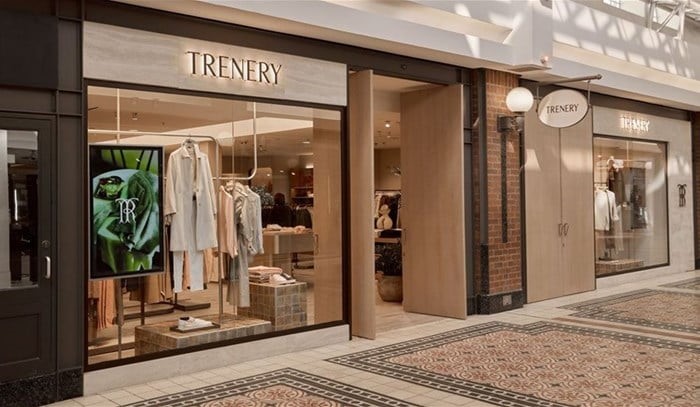
Image supplied
Trenery recently unveiled its brand-new concept store at the V&A Waterfront in Cape Town. Trenery has been in South Africa since 2009 as part of the Woolworths Country Road Group (CRG) and embodies timeless simplicity and sophistication offering premium apparel and accessories for men and women.
Trenery announced its rebrand in August 2023, unveiling a new vision and refreshed look. The newly revamped store boasts the rebrand, blending natural beauty and environmentally conscious design.
Store elements are responsibly sourced and include a range of locally crafted art and furniture.
Shoppers can look forward to a warm and inviting space featuring clay-rendered walls, soft lighting, and bronze fixtures. The ambiance is further elevated by commissioned works from local artists including, among others, Jan Ernst and MŪVEK Studio.
“We are very excited for our customers to experience our new space,” says CRG country manager, Kay Raidoo. “This is a significant and exciting step for Trenery as we introduce our refreshed brand in our latest global flagship store.” Bizcomminity
Pick n Pay – sales update and trading statement
The Company and its subsidiaries (“the Group”) increased total sales by 5.4% for the 52 weeks ended 25 February 2024 (“FY24” or “the Period”), with like-for-like sales growth of 2.9%.
Further trading statement
Shareholders were referred to the announcement released on the Stock Exchange News Service of the JSE Ltd. (“SENS”) on 22 February 2024. In that announcement, the Group advised that it expected to report a loss at the earnings and headline earnings levels for FY24, and that the anticipated loss was entirely attributable to the performance of the Pick n Pay Supermarkets business. The Group’s Boxer and Pick n Pay Clothing businesses remain highly profitable.
The Group is finalising its financial results for FY24 and expects its FY24 earnings to fall within the following ranges:
52 weeks to 25 February 2024 (expected range) vs. 52 weeks to 26 February 2023 (reported)
Reported earnings metrics:
*(Loss) / earnings per share (EPS): -686.01 to -637.33 cents per share vs. 243.37 cents per share
*Diluted EPS: -684.23 to -635.73 cents per share vs. 242.54 cents per share
*Headline (loss) / earnings per share (HEPS): -228.99 to -177.14 cents per share vs. 259.25 cents per share
*Diluted HEPS: -228.38 to -176.70 cents per share vs. 258.36 cents per share
Comparable earnings metrics:
*Comparable HEPS: -281.13 to -228.31 cents per share vs. 264.12 cents per share
*Diluted comparable HEPS: -280.39 to -227.75 cents per share vs. 263.21 cents per share
Recapitalisation plan and balance sheet update
Shareholders were referred to the Company’s cautionary announcements released on SENS on 22 February 2024 and renewed on 27 March 2024 and 13 May 2024, wherein the Group advised shareholders that the board of directors (“the Board”) had approved a two-step recapitalisation plan (“the Recapitalisation Plan”). Shareholders are reminded that the Recapitalisation Plan comprises a proposed renounceable rights offer to existing shareholders of the Company of up to R4.0 billion, expected to take place in mid-2024 (“Rights Offer”), followed by a proposed share offering and subsequent listing of the Group’s Boxer business on the Main Board of the Johannesburg Stock Exchange (“IPO”) expected to take place towards the end of 2024.
Classifieds:-
Cosy up to local creativity this Africa Day at Kuier@TheCastle
The Craft + Design Institute (CDI), in collaboration with the Castle of Good Hope, invites Cape Town locals and visitors to cosy up to creativity this Africa Day by exploring the diversity of local talent and several creative workshops for all ages on 25 May at the Kuier@TheCastle market. This month the market will be warming up visitors inside the Castle’s biggest halls, creating inviting new spaces to explore.


Flour Sacks
Flour distributors during the Great Depression used to add patterns and bright colours to their flour sacks, aware that many people at that time were using the flour sack material to make clothing.
Stories about the Great Depression seem alarmingly cohesive to our current times. Our school revision Of Mice and Men might ring in one’s ears with 2021’s re-examination of the American Dream, social inequality and of course – astronomical unemployment rates. But the Great Depression remains American history’s worst ever recession, and tales of how the American people, in local businesses, communities and industries, responded, are incredible to note.
This fact is one of these tales. Apparently, workers in American mills that stitched the flour sacks had begun to notice local women and children wearing the plain brown bags. Some sacks would simply be cut open at one end, for a tunic, and others would be repurposed into shorts, trousers or dresses. This practice is said to have started with farm women in South Louisiana, who would wash off the flour company logo and repurpose the sacks for clothing and houseware. Somewhere in one of these factory towns, someone had an idea.
By 1925, one company, Gingham Girl Flour, packaged its goods in dress-quality fabrics, and used its multi-purpose sacks as a selling point. Printed sacks were widely reused and companies continued to sell their products (seed, flour, sugar and oats) through World War II and into the early 1960s.

Editorial Submission:
Please remember to send me your news so that we can share it with all our readers in the weekly newsletter. Although editorial is neither guaranteed nor implied, suitable editorial for consideration may be submitted to:-
