
Newsletter No 15/2 May 2025

Click on any ad to go to the advertisers website

To agents, manufacturers, distributors & wholesalers. Please upgrade your 1 line listing to a business listing at least. The Sourcing Directory and Newsletter is dependent on industry support and your business listing offers potential clients more information about your company, products, branches, agents etc.
The cost of a business listing for the entire year is only R1400.
To add a logo is an additional R440. carla@newsbriefs.co.za


What South African consumers are sacrificing to stay afloat
By Lynette Dicey

Picture: Reuters/Siphiwe Sibeko
As living expenses rise, many are cutting back on entertainment, clothing and alcohol
When finance minister Enoch Godongwana delivered the 2025 budget on March 12, the nation wondered if the GNU was really taking the country’s cost of living crisis by the horns and wrestling it to the ground. Concerns about the impacts of VAT increases over the next two years, rising costs of debt servicing and the lack of decisive strategies to tackle rising consumer costs have risen out of the dust.
Brandon de Kock, director of Storytelling at BrandMapp, says: “By the fourth quarter of last year, South Africa’s consumer confidence index was at -6 points. It’s not the worst it’s ever been, which was -36 points in 1985, and far from the best at 26 points in 2018. But it’s a notable recovery from the recent pandemic lows, which fell to -33 points in 2020. Take a step back, and it looks to be a clear indication of the resilience of South Africa’s consumer class, who have quite a few tools at their disposal to deal with the rollercoaster of life.”
Shifting demographics in the consumer class
The latest BrandMapp survey, which tracks the behaviours and sentiments of South Africans living in households with disposable incomes ranging from R10,000 a month to the millionaire class, provides insights into how the consumer class (defined as adults who can freely buy goods and services above their basic survival needs) are financially managing their households.
Despite the sluggish economy and the cost of living crisis, De Kock says the important context to bear in mind here is that, according to the latest National Treasury data, the consumer class in South Africa grew at about 7.5% last year, which means it outpaced inflation.
“However, the growth of the consumer class is not spread evenly across the different income brackets. If you divide the personal income earners of South Africa into the core consumer class earning R10,000-R30,000 per month, the top enders earning R30,000-R80,000 and the millionaires earning R80,000 or more, you start to see some interesting shifts. The core represented 56% of all taxpayers back in 2020, but now it only represents 46%. It means there’s a significant rise in the top end with more than half of the consumer class (54%) now sitting in the R30,000 to millionaire income brackets. While this is obviously not great for the country’s Gini coefficient, it appears that while the rich are getting richer, the number of people earning relatively high incomes, living aspirational lives and driving potential growth seems to be increasing at an equally rapid rate.”
The costs South Africa’s consumer class are cutting
When it comes to strategies to deal with the rising cost of living, BrandMapp shows that there’s not much difference between middle-income and top-end earners, with the exception being that middle-income earners are 50% more likely to be considering getting a second job. About a fifth of the consumer class are thinking of cancelling DStv and spending less on alcohol and their mobile data packages, while less than 10% are thinking about cancelling some insurance and downgrading their medical aid.
“What’s interesting is to see that some of the habits we learnt during the pandemic are hanging around like long-Covid. About 35% of the consumer class are considering cutting back on clothing budgets, and 31% say they are likely to go out less to the movies and restaurants. All in all, with home grocery delivery, meals-on-wheels and streaming services, a mid- to top-income South African home is a comfortable place to be, and we have learnt that staying home more in our trackie pants is a relevant cost-saving strategy,” says De Kock.
Where you live shapes your cost-saving strategies
If you live in Gauteng, you’re more likely to deal with rising costs by working more, with 28% of the consumer class in the province saying they are open to taking on a second job. By comparison, a side hustle is only attractive to 23% of KwaZulu-Natal respondents and 21% of those in the Western Cape.
Gauteng consumers are also more likely to cancel DStv and cut back on alcohol. However, their enthusiasm wanes when it comes to going out less to movies and restaurants (31%) or staying home for the holidays (16%). By contrast, these are top strategies for Western Cape consumers, with 36% content to go out less and 19% considering staying home for the holidays — perhaps it helps to live in the country’s top tourism region. The top three cost-saving strategies for KZN are going out less to movies and restaurants (28%), getting a second job (23%) and cancelling DStv (19%).
How different generations are stretching their budgets
Not surprisingly, South Africa’s well-heeled boomers are the least likely to be thinking about any cost-saving measures, and at the other end of the scale, Gen Z and millennials are the most open to a wide range of ways to cut their expenses.
De Kock says: “What we see is that going out less to movies and restaurants, staying home more and cutting back on clothing budgets are major strategies across all generations, which mirrors our Covid cost-cutting habits. Millennials are the most likely to cut back on alcohol (24%), get a second job (30%), and spend less on clothing (38%), while Gen Xers are most likely to withdraw from their pensions (11%) and cancel DStv (24%). Among Gen Z, 36% are hoping that going out less to movies and restaurants will help get them through the month and 29% are considering staying home more, while 28% are thinking about changing where they shop to find the best prices.”
The cost-cutting gender divide — clothes and alcohol
Men and women are approaching the cost of living crisis in different ways. Women are 50% more likely than men to consider cutting their clothing budgets and changing where they shop for groceries. In a switch around, men are 50% more likely than women to be thinking of cutting back on alcohol and withdrawing funds from their home loans. Women are also more likely to be looking for a second job than men, and more willing to clean their own house.
In the end, lower prices win the day
For retailers and brands wanting to meet the South African consumer in the moment, it’s crucial to grasp how important pricing and promotions are across the mid- to top-earning households. “When we ask them about general shopping habits, 58% of South Africa’s consumer class say that they always look out for sales and discounts, with 34% revealing that the lowest price is the top factor when choosing where they shop — more important than convenience, quality and value,” says De Kock. “The youngest consumers are most hooked on the lowest price, with 39% choosing a store on this basis.” 

Three designers rewriting SA menswear
By Alexander Brand

Michael Ludwig Studio Motif Denim Blazer and Trouser Image: Michael Hittinger
Michael Ludwig, Ezokhetho and Siyababa Atelier are reshaping the space between streetwear, tailoring and cultural testimony at SA Menswear Week
SA Menswear Week (SAMW) AW25 arrives as a decisive declaration: menswear on the continent is evolving, and fast. Three rising designers — Michael Ludwig, Ezokhetho, and Siyababa Atelier — are reshaping the space between streetwear, tailoring, and cultural testimony. Their collections speak to memory, identity, and the unapologetic act of becoming.
Michael Ludwig Studio: The architecture of blooming
“Abundant Anthesis reminds us that the process of growth and self-discovery is what truly matters,” says Michael Ludwig Hittinger, creative director of Michael Ludwig Studio
Inspired by the indigenous Black Orchid, Michael Ludwig’s Abundant Anthesis is a study in duality and internal transformation. The collection honours “blooming within oneself and for oneself,” balancing structure with softness, formality with fluidity.

Micahel Ludwig Studio Tweed Calyx Wrap Skirt and Tweed Calyx Crop Blazer Image: Michael Hittinger
The Tweed Calyx Wrap Skirt flares like an opening petal, paired with a cropped jacket and Matisse-inspired white denim embroidered in crimson — encapsulating floral anatomy.
Ludwig’s Motif Denim Suit in ivory and red embroidery is a harmonious union of natural inspiration and sharp tailoring that resists traditional gender codes.
Ezokhetho: Love, loss, and legacy
“ZODWA is a tribute to love that endures, even in absence,” Mpumelelo Dhlamini, founder and creative director of Ezokhetho, says.
Where Ludwig looks inward, Ezokhetho looks backwards — not in nostalgia, but in reverent remembrance. ZODWA is named after the affectionate nickname the designer’s father gave his mother, and emerges as a textured love letter to black SA partnership during the 1980s and 1990s. It’s the label’s first menswear collection, and its most emotionally charged collection yet.
Tailored pink pinstripe short suits sit beside jagged-panel slip dresses in vibrant animal print, echoing an era of post-apartheid optimism. A voluminous pink, jacquard dress with balloon sleeves and yellow trim channels Sunday best with an elegiac twist.
Most memorable is a power suit in shimmering patchwork, worn seated and styled with confidence — a regal stance that speaks to legacy, glamour and memory.

Reverent remembrance is top of mind for Ezokhetho founder, Mpumelelo Dhlamini, and it shows up in echoes of a boldly optimistic era Image: Ezra Kofi Qua-Enoo
Siyababa Atelier: When grief wears colour
“This isn’t about mourning in silence. It’s a celebration of life, love and legacy,” says Siyabonga Mtshali, founder and creative force behind Siyababa Atelier.
With Siyazila — which translates to We Are Grieving — Siyababa Atelier returns to SAMW with a collection that transforms personal loss into vivid, wearable memory. Dedicated to founder Mtshali’s late sister, Nontobeko Mtshali, this body of work doesn’t shy away from pain — it channels it into power.
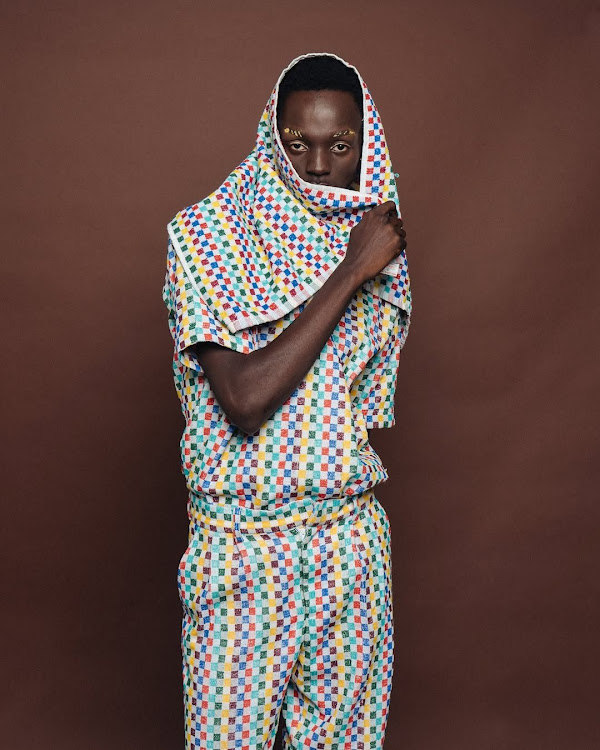
The collection builds emotionally and visually. Before Siyazila, Mtshali introduced garments that explored disorder and transition: grid-printed co-ordinates, painterly tailoring, and lace against structured silhouettes. These were statement pieces and signals of emotional turbulence, of a designer laying the groundwork for something deeper.
Then Siyazila emerges, unapologetically bold. Sculpted, leopard-print pieces twist around the body with intent, revealing metallic lace and bare skin. Zebra-striped hoods and draped silhouettes speak in the language of ritual — garments not just worn, but inhabited. The use of colour and texture is assertive, drawing grief into sharp focus and refusing to let it be backgrounded.
The pieces of Siyababa Atelier’s previous collections laid the groundwork to explore disorder and transition Image: Luke Ncube
This season, Mtshali collaborated with visual artist Zandile Tshabalala to create a custom garment that merges the brand’s expressive silhouette with Tshabalala’s signature painted language. LIKKYLIKS, an experimental musician and artist, brought sonic texture to the collection, transforming its emotional moodboard into a soundscape. The installation’s video component, shown at SAMW, was directed by Retang Sebeka, whose lens layered the garments with narrative resonance.
These collaborations extend Siyazila beyond fashion and into a multisensory meditation on mourning and memory. It’s a diaristic body of work: sharp, intimate, and impossible to ignore. Mtshali doesn’t design grief as absence — he designs it as presence.
The future is now
While global fashion wrings its hands over algorithmic designers and shareholder-safe choices, SA’s emerging voices are doing something else entirely: they’re making work rooted in truth, not trends.
Michael Ludwig speaks to internal blossoming, Ezokhetho honours enduring love in the face of grief, and Siyababa Atelier turns mourning into modern mythology. Together, they represent a future of fashion that doesn’t ask for permission — it simply begins.

Jonathan Anderson named new artistic director: Dior menswear

Source: www.voguebusiness.com
Jonathan Anderson, the fashion designer from Northern Ireland who brought success, cool and viral fame to the Spanish label Loewe during his 11-year reign, has been announced as the new creative director of Christian Dior’s menswear collection.
Anderson is known for his innovative styles and gender-fluid designs, and has created some iconic looks, including Rihanna’s 2023 Super Bowl halftime performance attire and Ariana Grande’s 2024 Met Gala gown.
The move is part of a major reshuffling of jobs at global fashion brands following some resignations and forced departures.
In January, English designer Kim Jones stepped down as Dior’s artistic director for menswear, leading to speculation that Anderson would succeed him.
Dior confirmed Anderson was working on the Dior Homme summer 2026 collection, which he would present in Paris in June this year.


Wardrobe Malfunctions

Eric Robert / Sygma via Getty Images
In a since-deleted Instagram post, Kate Beckinsale shared a story about the time Keanu Reeves saved her from a wardrobe malfunction when they were promoting Much Ado About Nothing at the 1993 Cannes Film Festival. She said, “I had bought the bodysuit in the Sock Shop at the airport, and when I got in the car to drive to the premiere with Denzel and Pauletta Washington, all the poppers in the crotch popped themselves open, and it flipped up like a roller blind. I didn’t feel it was appropriate to go delving around in my undercarriage with all of us in the back of the car, so I just quietly panicked.”
She continued, “I walked out onto the biggest red carpet of my life and whispered to Keanu and Robert Sean Leonard what had happened. In this picture, I am holding the front gusset down, and the two of them are holding the back gusset. Absolute legends who may not even have fully understood the physics of what was happening or even heard the word ‘gusset’ before, but both jumped in to save me, no questions asked.”

Editorial Submission:
Please remember to send me your news so that we can share it with all our readers in the weekly newsletter. Although editorial is neither guaranteed nor implied, suitable editorial for consideration may be submitted to:-
